
Key Highlights
The UK Educational System is set for change amidst a saturated job market, growing unemployment, AI technology, and instability among universities. But there have been some critiques of the Government's plans from those representing under-privileged areas.
The UK Educational System is set for change as students’ careers hang on the line, due to the University instability, child poverty, and a competitive job market.
British schools are set to roll out V-levels at the start of 2027. These qualifications will sit alongside other current level-3 qualifications, such as A-levels (academic) and T-levels (technical). While these pathways usually require higher level-two qualifications (i.e. GCSEs), this new vocational route will offer an alternative for those who did not get the desired grades. This includes “young people with special educational needs and disabilities (SEND) and those from socio-economically disadvantaged backgrounds.”
For pupils aged 16+, it is an opportunity for them to develop the skills they need for future jobs, and “make sure they have access to meaningful and rewarding destinations.”
The Department for Education’s latest review of the curriculum, assessment, and qualifications system in England is hoped to “ensure that every young person has access to an excellent education, and develop a thirst for learning…”
It is in response to the Government’s Interim Report, which brought attention to areas that needed improvement, such as qualifications for those aged 16-19.
Schools North East, a registered charity and a school-led regional network, shared their perspective on the report. In a press release, they welcomed many changes and how it reflected their own submissions to the review. This included reducing exam burden “by at least 10%...and efforts to make checks fairer for pupils with SEND”.
However, there was scrutiny over failure to “tackle deeper structural challenges facing schools in regions with entrenched disadvantage and increasingly stretched resources.” Delivering a reformed curriculum may be limited due to the already existing lack of infrastructure and investment in many North East Schools.
Similarly, the National Educational Union was glad to see responses to areas of concern.
“It is a relief that the review has listened to teachers, parents, and campaigners and abolished the EBacc (GCSE options),” Daniel Kebede, general secretary of the NEU, said, “The EBacc has narrowed the secondary curriculum and squeezed the arts out.”
But the union was disappointed that there was no “push for a wider, fairer range of secondary assessment methods beyond only end-of-course exams, so that young people can successfully demonstrate what they can do.”
Again, there was scrutiny over how the review approached underprivileged children.
“The elephant in the room is the lack of investment in education and the social conditions of children and young people,” Kebede commented, “...Children should not be growing up in poverty, and government action to reduce child poverty is overdue. “Likewise, school funding is in a dire state, with 86% of schools seeing real-terms cuts in 2025/26. If the government were serious about unleashing opportunities, they would not tolerate this situation.”
“Poverty is the central barrier to improving education outcomes.”
Daniel Kebede, General Secretary of the National Educational Union.
The Current System and the Skills Gap
People are struggling to find work and progress due to a lack of opportunities and skills; 8.5 million adults in the UK have low proficiency in English, Maths, or both. Consequently, they are being held back.
Qualifications can benefit people greatly, as Government findings from 2023 showed those who attended higher education earn more than those who don’t.But, higher grades are not the sole indication of someone’s career, as those from disadvantaged backgrounds are “less likely to attend university or study subjects associated with higher earnings when compared to their wealthier peers, despite similar grades.”
A lot of factors show that working-class students may be set up to fail in the education system. Some point out that a lack of access to educational resources (such as books, revision materials, tutors, and even a good diet) can limit their potential. Parental influence could have an impact, as parents from upper-class backgrounds are more likely to have attended university.
Higher Education Under Pressure
This shift in UK education may be needed as older routes (such as university) begin to fracture. English universities have collectively cut 12,000 jobs in the past year, as four out of ten are believed to be in financial deficit. Then, analysis of Government policy decisions found that funding to higher education providers is estimated to be cut by £2.5 billion.
“Young people from all backgrounds feel they have been let down by a system that talks about opportunity but too often fails to deliver it.”
In the 2025 Post-16 Education and Skills Policy Document, ministers say they will “increase the maximum tuition fee cap in line with forecast inflation” to improve the financial stability of universities.
The Current Job Market
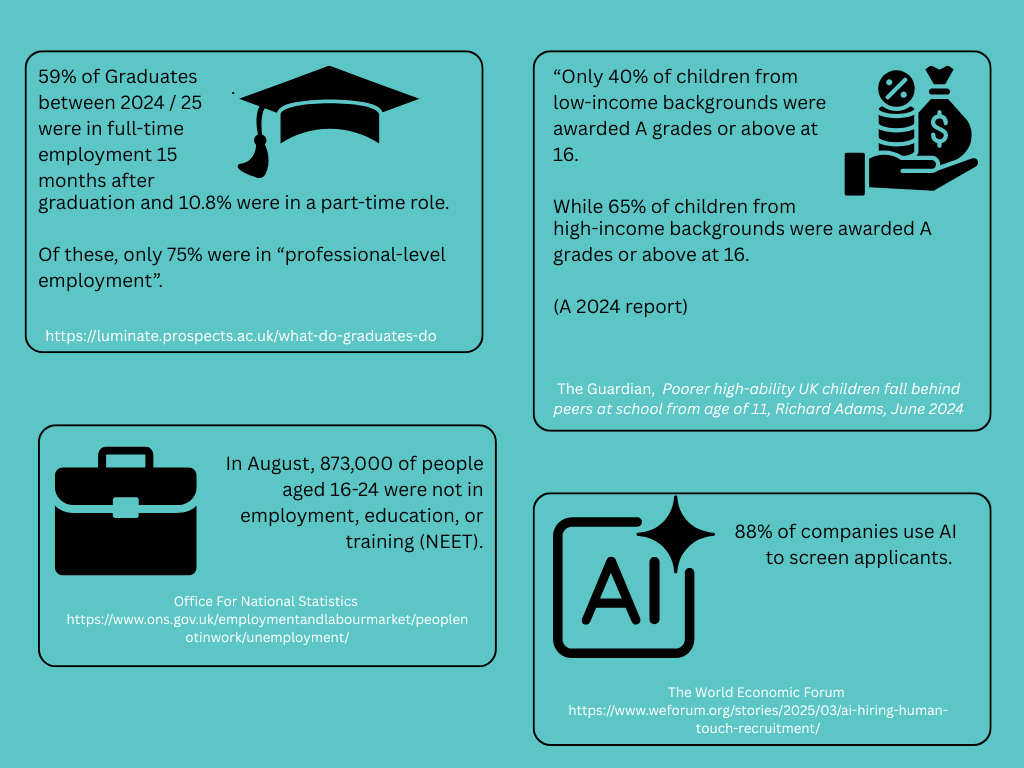
A vast number of graduates are struggling to get an entry-level job with their qualifications. The number of roles advertised for recent graduates fell by 33% in mid-June. It’s a staggering realisation for those who followed a path they believed to be correct.
Final-year university students securing a job by February before graduation has fallen by 6% in the past two years, the lowest since the pandemic (2021). In 2021, research found that 35% of entry-level jobs require three levels of experience, and 60% of jobs are in software. Of the people who completed an apprenticeship between 2020/21, 93% sustained employment compared to 87.7% of graduates.
For many, it can feel like the education system failed them because they aren’t getting the careers they worked for their whole life for.

Dan Younger at CY Partners, a science, technical, and clinical recruitment agency, spoke about the current atmosphere for young people and graduates.
Recruitment agencies don’t just help individuals to find a position, but also help write a CV, build a social media profile, and network with potential companies - overall “supporting people through that process.”
Younger comments that the job market is really competitive and challenging right now. He points out it is tougher currently and (overall) there are” less jobs available, certainly in life sciences.”
“Applying for jobs is a much more automated process,” he says, “[it’s] less people involved.”
The World Economic Forum reported that 88% of companies use AI to screen applicants. This new software is supposed to act as a helping hand for hiring managers to sort through thousands of candidates. However, there are definitely concerns about biased selection processes.
So, how do graduates progress and break into their careers? Younger says experience is vital. Whether it’s volunteer work or a part-time job, these roles can make you stand out. Speaking within his own sector, companies are not just looking for scientific or technical knowledge, but also softer skills, such as working well in a team. “It’s gaining that exposure not just in that type of company you want to work with.” Of course, he acknowledges it’s not always easy: “There’s always that Catch-22 of how do you get experience without people offering you that.” He advises students to plan ahead: creating a network and building a social media profile.
“Be prepared to move and be prepared to relocate,” he informs job-seekers, yet acknowledges “not everyone is in a position to do this.”
Social, economic, or technological - factors, such as the cost-of-living crisis, a saturated job market, and the rise of AI, are hindering people from building a comfortable and functional life. Now, more than ever, education matters to help set the younger generation up for a future brighter than this.
These V-levels have been created to help ease students into employment. Although they hinge on inclusion and fairer opportunities, they do not address issues of child poverty or school funding. Both are detrimental to many children’s futures.