Key Highlights
The National Grid have now received the green light to go ahead with their Norwich to Tilbury power line plan. With the plans launched in 2022, there has been increased pushback from local communities and councillors. Green Party representative Catherine Rowett shares her concerns about the plans and how they will impact both local communities and the environment.
It is now one year until the start of the National Grid’s (NG) Great Grid Upgrade. The NG is planning to construct a 114-mile network of 50-metre-tall pylons to expand the UK’s ability to carry clean energy.
The project was initially launched in 2022 and planned to have the line run from Norwich to Tilbury, crossing three counties - Norfolk, Suffolk, and Essex. However, the NG has not escaped criticism for its plans, having faced uproar from both local politicians and community members.
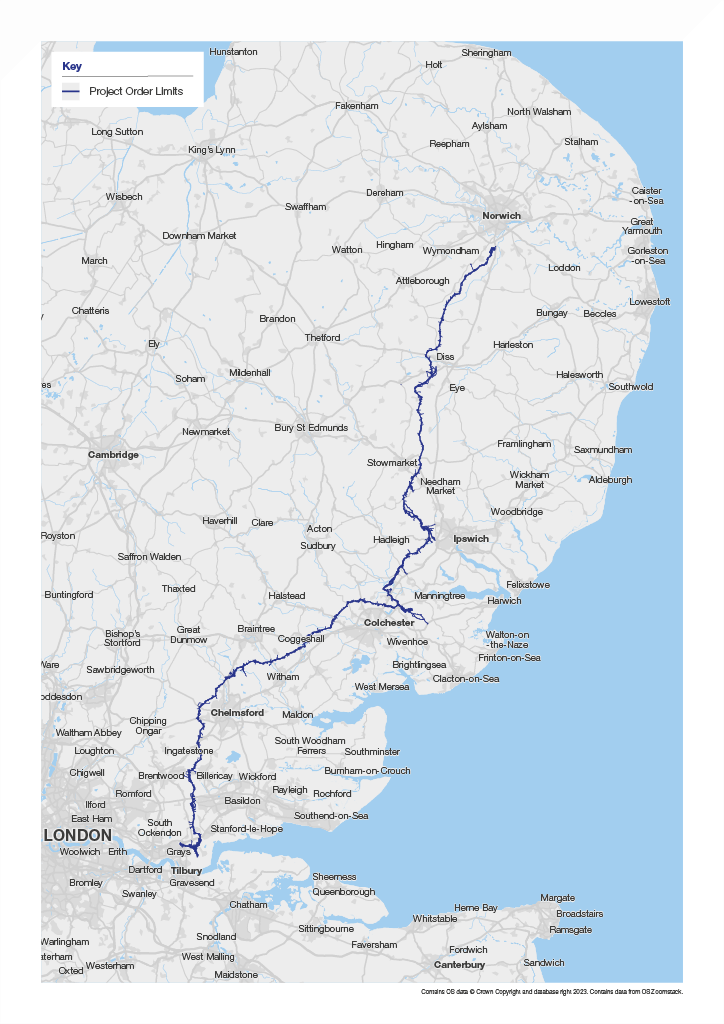
The planned route for the pylon line (Image: The National Grid)
Despite the plans continuing to move forward, many individuals are still expressing concerns over the impact of the pylons and their construction. Not only will they alter the lives of those in the affected areas, but their construction will undoubtedly disturb the surrounding environment.
After reaching out to the National Grid for comment, their spokesperson said that “The Norwich to Tilbury project is vital for delivering home-grown British energy from more affordable sources to meet rising demand in East Anglia and across the country.”
When speaking with Catherine Rowett, member of the Green Party and County Councillor for West Depwade (the area of Norfolk most affected by the construction route), she outlined the negative impact the building process would have on the environment:
“There are chalk stream habitats and wet woodland; if these are damaged, you’ll get pollution in the waterways”. Rowett further noted the disruption that would inevitably be caused to local species, “Deer and hedgehogs use hedges as corridors to get to their feeding locations; if you cut straight through these, those mammals will be disrupted.”
In response to Rowett’s environmental concerns, the NG stated that they “always carefully assess any potential impacts and consider how we might avoid, reduce, or mitigate them. We do this by undertaking ecological and archaeological surveys, alongside consultation with local and national wildlife experts, to ensure we fully understand the environment in the area.”
The NG also claimed that they aim to deliver at least 10% net gain in environmental value, including biodiversity net gain (BNG) on their construction projects. Their project and methods were outlined in their Environmental Statement.
Rowett has also been active in her community, echoing the worries of locals who have consulted her about their concerns:
“Everybody is upset and distressed about the pylons, because they went to live there (Norfolk) for open skies and beautiful views. These unspoilt and remote areas matter to members of the community, partly for their own peace and also for their children to grow up in unthreatening areas.”
The vital need for green energy adds complexity to the situation, with Rowett also voicing the other perspective held by locals on the plans:
“On the other hand, a lot of people also think that it’s important to have a sufficient energy grid to take on board the energy we produce here, and many people concerned about the climate crisis want to move towards renewable energy.”
Although Rowett outlined the importance of balance when approaching the need for green energy, she suggested that the NG has not taken such a balanced approach, ignoring the environmental cost of the construction:
“All developments have a tendency to damage nature to some extent, but as I perceive it, the current ways in which planning is done discount nature and only pay attention to whether human infrastructure is protected.”
When asked what she believes would have been a better route, Rowett stated, “They should have looked for the places already spoiled. If you go down a route where there is already housing, industry, roads, and railways, it may be more awkward, but it doesn’t go through the natural, unspoiled areas.”
The NG has attempted to connect with local communities affected by their plans, holding consultations to address people’s concerns and issues. However, Rowett, again echoing the idea held by many locals, called these attempts a “performance”:
“There’s an assumption that these consultations are meaningless, and people’s concerns and suggestions have been ignored. They have only taken notice of things that require little tweaks, mainly to do with people’s commercial interests. There is no sense of paying any attention to protests about nature, or route differentiation.”
In relation to their consultations, the NG insisted that they have been listening to people’s concerns:
“We’ve been listening to local communities and representatives over the past three years to help shape our Norwich to Tilbury proposals. Through hundreds of consultation events, online forums, and direct conversations, the project received around 20,000 pieces of community feedback, with numerous changes made to the project.”
According to the NG, these changes include the introduction of an underground cable section near Great Horkesley, close to Dedham Vale National Landscape, where a section of the line will be going underground.
Although the project’s environmental impacts are currently dominating the conversations surrounding the pylons, Rowett also pointed out that the energy security crisis must also be considered:
“There’s the climate crisis and energy security crisis to consider, not wanting Russian gas, oil and nuclear fuel.”
The topic of the energy security crisis continues to become more prevalent as Russian tankers sanctioned for carrying illegal Russian oil have been spotted across the English Channel. When speaking with Rowett, she suggested that, in addition to the climate crisis, this issue is prompting people to shift to homegrown renewables rather than mass-produced energy.
Martin Robertson, who lives within the Waveney Valley - an area represented by the Green Party, and one that the pylon line will pass through - has voiced his apprehension towards the NG plans:
“I live within one mile of the proposed pylon lines, which I will be able to see from the front of my house. Although I understand and support the need for green energy, I struggle to understand why the National Grid feels that the long-term solution is an above-ground line that will blight the countryside for generations.”
When asked whether the NG had contacted him at all, Mr Robertson recalled receiving a leaflet “over two years ago” that briefly explained the options they were considering at the time and what might happen in the future.
However, Mr Robertson still feels that there has been little effort made by the NG to consult people within the local communities impacted, saying, “It feels that for something that’s a major change that will impact people, that there is little interest to seek feedback from those same people.”
Mr Robertson mirrored the views expressed by Rowett, saying, “It will disturb the peacefulness of my current environment”. He also voiced concern over the impact that the pylons could have on the value of his home and plans to potentially move:
“If I were to seek to move home, I could see myself losing some money because the pylons will be seen from my front door, even though they’ll be a mile away.”
When questioned about public compensation, the NG said that “any claim would be treated on an individual basis”, however “UK law does not require us to compensate for loss of view.”
The Great Grid Upgrade has undoubtedly been a drawn-out process that, in the eyes of individuals who live in the affected communities, has failed to consider the many potential outcomes and impacts of its construction process.
Whilst local councillors, like Catherine Rowett, recognise the impending necessity of clean energy, they feel that it is impossible to ignore the negative effects that this project will inevitably have on both the environment and those who live locally.