🎧 Listen to the Article
This audio is AI-generated for accessibility.
Key Highlights
Every year, especially during the winter months, Delhi struggles with poor air quality and high concentrations of harmful, tiny pollutants. These pollutants are not visible to the human eye but are easily capable of affecting people’s health and vital organs once inhaled. Through expert opinions and the lived experiences of residents, this article examines how deeply poor air quality has impacted people and how they struggle to survive in India’s capital amid a crisis that demands urgent attention.
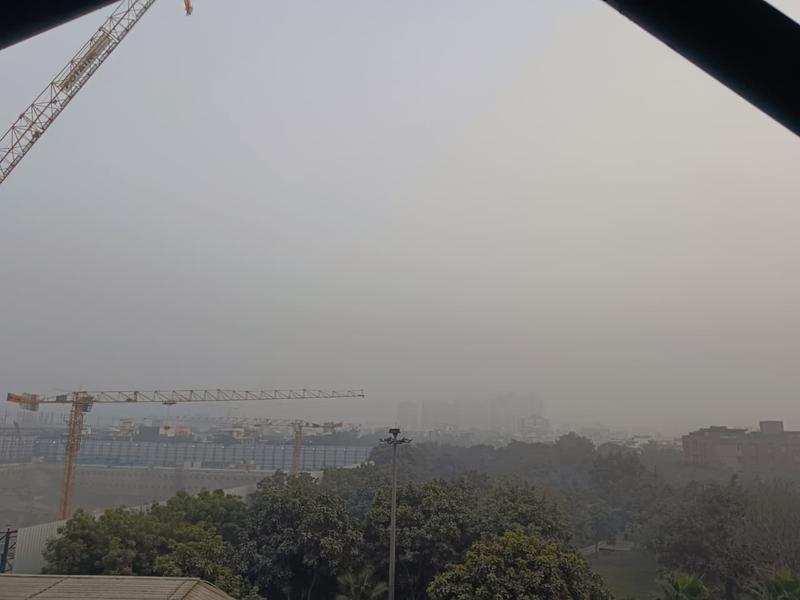
One fine evening, just a few days back, Poornima woke up and went to her balcony. She was surprised to have a clear vision of her neighbours’ balcony. After weeks, her surroundings became clearly visible, free from smog, tiny pollutants, and other dust particles. Not to her surprise, smog returned the next day. By now, you have guessed the city, and you’re right, it’s none other than New Delhi, the capital city of India. It’s a city where residents are, somewhere, now becoming used to or forced to live under hazy, toxic, contaminated air, with winter smog making it even worse. It is a city that has consistently been ranked among the most polluted in the world by various international reports and studies, including the AQLI report.
Over the years, Delhi has ironically become a city where an AQI of 300-400 is seen as 'better' air compared to earlier days. Even an AQI of 700 is called ‘hazardous,’ but it still isn’t enough to shut offices and colleges, forcing people to step out and get directly exposed to the pollution. According to the World Health Organisation’s air quality standards, this level is unfit for breathing and has serious long-term health effects on people living in the city. But does it seem like Delhi NCR’s people have now become immune to toxic air with ‘Iron Lungs’, by living and carrying out their daily life routines as usual?
This is the surface reality, as lived experiences tell a different story. The people's ways of living are quietly getting shaped, and their life span is being affected by the deteriorating air quality of the city. Perhaps they are living in this city, going to offices, travelling, and appearing for examinations because they have no other option. The people want to know, when will the residents get to breathe clean air—something that today seems like a privilege, but in reality is a basic human need?
The air pollution in Delhi is no longer a seasonal environmental issue; it has become a year-long crisis. Several environmentalists, doctors and experts repeatedly underscored that the deterioration of air quality in Delhi during winters is an ‘established event’.
We have interviewed Dr Gaurav Pandey, an accomplished consultant and senior pulmonologist, with 11 years of experience, who also runs a private clinic in Delhi. He speaks about Delhi's pollution, saying it's not just a seasonal crisis but a major year-round issue that continues to severely impact the overall health of Delhi residents. He further emphasised that during the winter season, “decreased air movement” prevents pollutants from dispersing quickly in Delhi’s air, allowing them to linger and increase residents’ exposure to inhalation.
Additionally, the presence of other bacteria and viruses in the environment triggers acute exacerbations in people already suffering from other diseases. He then adds that AQI levels typically range from 200+, which is unhealthy for people to inhale regularly, while in winter, it rises to around 500, making the air extremely hazardous to breathe.
Among the most harmful pollutants in Delhi’s air is Particulate Matter 2.5 or (PM2.5), which can cause serious lung damage. PM10 also accounts for harmful pollutants, both present in the form of dust particles. Gases like Sulfur dioxide, Carbon monoxide and Carbon dioxide from vehicular emissions, and smoke from factories, further contribute to harmful pollutants present in Delhi’s air.
Upon asking Dr Pandey, ‘Do air pollution cause permanent damage and irreversible damage to lungs?’ he replies, people continually exposed to high pollution air levels for a prolonged period of time, like 10-12 years, the damage to their body is serious, often difficult to reverse the impact on lung tissues. He gave an example of a disease known as Chronic Obstructive Pulmonary Disease (COPD), which is an irreversible damage to lung tissue, is common to people who are passive smokers, but for people living in Delhi NCR for 15-20 years in an area with severe pollution, the micro-level changes and tissue distortions in the lungs are possible consequences.
In the long run, people residing in high-pollution areas are at risk of lung tissue disorders and related diseases at older ages. Underscoring the impact of pollution, he says, the impact is not only restricted to the lungs, but it can also cause other serious health concerns, such as stroke, heart-related problems, etc.
In recent years, there has been a rise in asthma, Chronic Obstructive Pulmonary Disease (COPD), interstitial lung diseases, acute exacerbations of sinusitis and other respiratory distress among patients in his clinic, he shares. Cases of people suffering from allergies due to dust particles have also risen in this season; however, these are associated with multi-factorial reasons along with pollution.
In a report by ETV Bharat, while speaking to Jitendra Nagar, an environmentalist and a professor at the Department of Environmental Sciences in Delhi University, reflected on how Delhi Pollution is a year-long issue and it should be treated as such. The professor also stressed the urgent necessity for clean air in the city, and it’s no longer a luxury.
What does the AQLI Report 2025 find about air pollution in India?
Several reports and surveys by eminent established institutions find Delhi to be the World’s most polluted city, where people lose at least 8 years of their life to air pollution. One of such studies is the Air Quality Life Index (AQLI) 2025 report produced by the Energy Policy Institute at the University of Chicago (EPIC). The latest edition of this report reveals the extent to which air pollution is estimated to shorten lives, and for the eighth consecutive time, New Delhi tops the global list in this parameter.
The report also reveals that in India, the particulate matter concentration in 2023 was 41 µg/m³. It is more than eight times the WHO's prescribed level (5 µg/m³) in its guideline, and slightly higher than the country’s national PM2.5 standard of 40 µg/m³. As compared to 2022 data, PM levels increased by 1.2 per cent in 2023 in the country’s atmosphere.
The report highlighted that increased PM levels could reduce the life expectancy of an average resident in India by 3.5 years, while the residents of Delhi and its surrounding area could live up to 8.2 years longer if particulate concentration were brought in line with WHO guidelines. NCT of Delhi has the highest concentration of fine particulate matter of 2.5, with 88.4 micrograms/cubic metre (µg/m³).
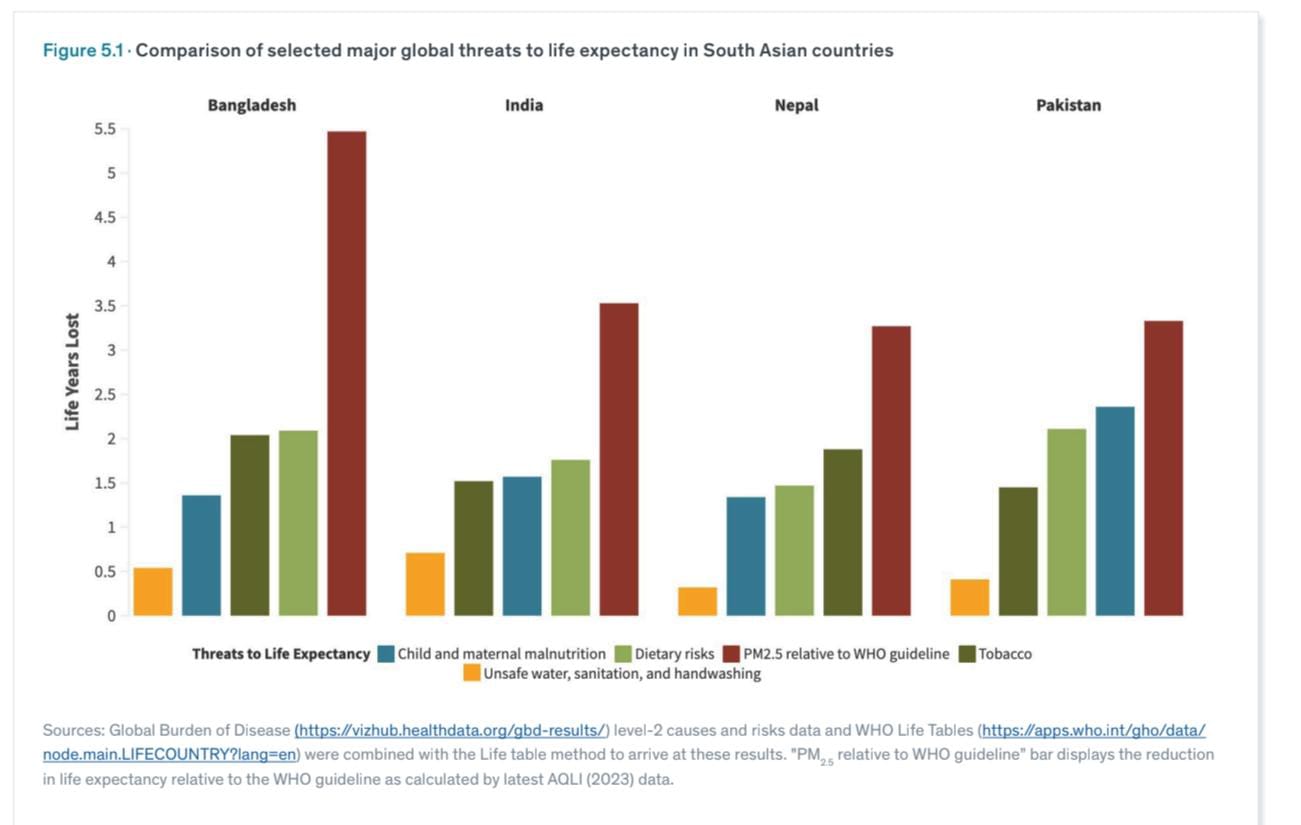
However, the AQLI 2025 report also reveals that India’s capital has topped the list for eight years, but the data, compared to previous years, shows a declining trend. The potentially reduced life expectancy of almost 10 years in 2018 has improved to 8.2 years in the latest report of 2025. An article by The Times of India covered the AQLI 2023 report, which highlights that PM2.5 is estimated to shorten the average life expectancy of residents by 11.9 years in Delhi, considering the WHO standards of 5 µg/m³, and 8.5 years if the national air quality standards of 40 µg/m³ are not met.
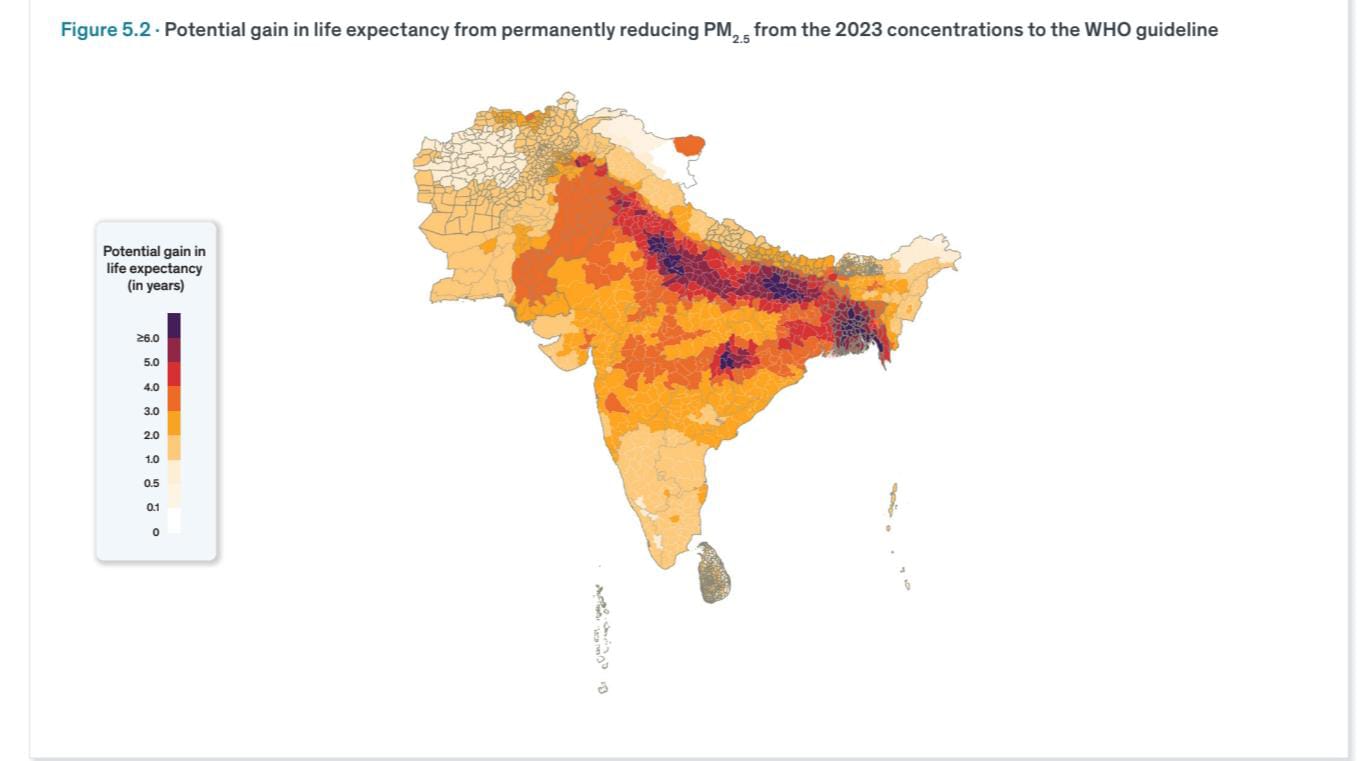
The report was prepared based on data from two years prior, which means that 2025’s report reflects the 2023 data, and 2018’s report reflects the pollution levels of the year 2016.
What has been the experience of people living in Delhi?
A girl from Kashmir, 18, who has been living in Delhi since last year, shares her experience of visiting the capital and inhaling its air for the very first time. She shares coming from a place which is “absolutely covered with trees, mountains and blue sky,” living here for her has been “challenging and shocking.” “Starting from November, I’m constantly coughing. Coughs and colds have become routine, and I often experience irritation in my throat and eyes. Sometimes, I also have to breathe harder due to the high pollution levels”, she added. She further shares that whenever she goes outside wears a mask, and drinks lukewarm water on her mother’s advice as a precaution to reduce the impact.” “Since moving here, I’ve been struggling with excessive hair fall and skin allergies,” she says, attributing the problem not only to poor air quality but also to contaminated tap water.
Another 23-year-old woman shares that she lived in Delhi for a week due to her office commitments in November, whilst during her week-long stay, she started feeling difficulty in breathing in just 3 days. “I immediately consulted the doctor after returning home, and the doctor asked me, ‘Do you live around someone who is a passive smoker?’ Later, the test reports reveal it's because of the congestion in the lungs caused by pollution in Delhi,” she added. Her office is situated in Noida, and she used to travel by metro. “The sky was grey, completely covered with smog and haze, which was a horrifying sight and air to breathe,” she further adds.
How effective have the government's initiatives been in tackling the pollution crisis?
Every assembly election, parties’ manifesto comprises of an agenda to clean Delhi’s air and ensure the residents a healthy and safe atmosphere to breathe, so that their priceless lives are not at risk, and life expectancy is not reduced significantly as a cost of living in Delhi. The government announces actions and discusses policies, yet the crisis remains largely unchanged over the years.
The Aam Aadmi Party (AAP) was in power in Delhi for ten years until 2025, when the Bhartiya Janta Party (BJP) concluded its rule in Delhi by winning the February 2025 Delhi Assembly Elections. Now, the timely question that arises is, in those 10 years, what measures did AAP take to make Delhi’s air clean, and what changes did it bring?
An article released by the AAP party in 2019 mentions nine key measures taken by Arvind Kejriwal to reduce pollution by ‘25 per cent.’ The measures include are such as, implementing the Environment Compensation Charge, imposing heavy fines for construction during peak pollution season, increasing the city’s green cover, banning coal, promoting e-vehicles, etc.
However, the pending CAG report tabled by Delhi CM Rekha Gupta in April 2025 reveals that there were many discrepancies in monitoring AQI by the previous government. The locations of Air Quality Monitoring Stations did not meet the Central Pollution Control Board requirements, making AQI readings unreliable. The government did not conduct any study on pollution sources and does not have any real-time information on them. The report also revealed a heavy shortage of public transport and flagged many other issues.
Initiating measures, implementing policies, and planning schemes on curbing pollution did not make much difference to AQI levels of Delhi, especially during the winter season. Air levels rise every year to the hazardous category, making headlines, and costing the priceless lives of people.
BJP, in its 2025 election manifesto, vowed to reduce the average AQI and PM2.5 and PM10 levels by half in the next five years, if elected.
In December 2025, Ashish Sood, a Delhi Minister, says that Delhi pollution is not a seasonal crisis, but rather a result of years of policy failures. He blames the AAP party for the high pollution in the city and cites data manipulation by it.
On December 18, 2025, Union Minister of State for Environment and Climate Change Kirti Vardhan Singh (BJP) told the Rajya Sabha that there is no "conclusive data" to establish a "direct correlation" between higher Air Quality Index (AQI) levels and specific lung diseases. The Minister stated that health impacts are a synergistic manifestation of various factors, including lifestyle, socio-economic status, immunity, and genetics. While denying a direct link, he acknowledged that air pollution is a "triggering factor" for respiratory issues.
Several reports and opposition parties also accused the BJP of manipulating pollution data in Delhi by spraying water near the AQI monitoring machines. A report by India Today, ‘Delhi AQI discrepancy: Ground readings much worse than official data,’ investigated that while official figures reflect improvement in the overall AQI levels, on-the-ground data reveals a stark difference. Areas such as ITO, India Gate, Anand Vihar, and Lodhi Road revealed faulty monitors or a stark difference between online AQI and ground measurement. It also mentions that MCD trucks are continuously spraying water near the monitors to keep the official readings down.
Affordable & Simple Household Remedies
Dr Pandey emphasises the effectiveness of traditional remedies to reduce the impact of pollution on the human body. “Regular use of turmeric, tulsi (basil), aadrak (ginger), onion, and garlic in meals are natural method to increase the anti-oxidant properties in the body,” said the doctor. He further added that in high pollution seasons, our bodies are in an “inflammatory state” (damage state), and such natural anti-oxidant sources work well, if taken adequately. However, he also notes that individuals experiencing serious symptoms should consult a doctor first, as such remedies serve only as precautionary measures in a controlled state.
Outdoor Activities during High Pollution Episodes
Dr Pandey highlights that children under 12 years, adults above 50 years, and those already suffering from chronic diseases like asthma are the ones highly vulnerable to pollution. These people should avoid stepping out in the early morning and late evening, as PM2.5 concentrations are at their peak during these hours.
He also raised concerns regarding outdoor activities such as morning and evening walks, and sports events such as marathons, during peak pollution seasons. Such activities should be avoided during the early morning and late evening, when dense particles settle closer to ground level and are more easily inhaled, he further added.
On 14th January 2026, World No.3 Badminton player withdrew from the ongoing India Open 2026 in New Delhi. Andres Antosen cites the capital’s “extreme air pollution” as the reason for withdrawing, incurring a fine of nearly Rs 4.21 lakh by the World Badminton Association. He called the city “not a place to host a badminton tournament at the moment,” and highlighted AQI levels between 300 and 400, which he deemed unsafe for elite athletes.
Global Spotlight on North India’s Polluted Air
Amid the high pollution level months, the crisis is not only limited to the country; the world has become alert to it. Several countries’ media and press are reporting on the ongoing pollution crisis in India, citing Delhi as an ‘unliveable’ city. Le Monde reports that Delhi is no longer a liveable city, and pollution claims 17,000 lives every year in the capital. Bloomberg reports Delhi as the ‘Smog Capital of the World.’
The protests concerning the same are also making headlines and are being reported by news agencies globally. Al Jazeera covered outrage over pollution in Delhi, and reported ‘I just want to breathe’ as protesters struggled to breathe. The Guardian also reported the protests, ‘I can’t breathe in this city’: inaction over Delhi’s suffocating pollution sparks rare protest,’ cites the failure of the state government to do anything about pollution— screams apathy.
In mid-December 2025, the Singapore High Commission in New Delhi issued an advisory, asking its nationals residing in Delhi-NCR to stay indoors, wear a mask and “pay heed” to GRAP-4 measures as the air quality was turned to ‘severe.’ The advisory also flagged likely flight disruptions due to low visibility. The opposition party slammed the government and termed it an ‘international embarrassment.’ Apart from Singapore, the U.K. and Canada authorities in India also issued travel advisories related to air pollution in Delhi.
Gita Gopinath, former deputy managing director of the IMF, during a session at the World Economic Forum (WEF) in Davos, says that pollution is a serious economic threat to India, its impact is larger than trade-related challenges, and urges urgent action on a national priority.
She further says, “If you look at the annual cost to India’s GDP of the level of pollution, and it is not just the effect on economic activity, but it is also the loss of lives. The numbers are really large.” Gopinath cited a 2022 World Bank study that found pollution causes about 1.7 million deaths in India each year. It accounts for nearly 18% of the country’s total fatalities.
Steps at the individual level to mitigate the impact
Dr Pandey, on being asked about the usefulness of ‘pollution masks,’ says a specified type of mask needs to be worn while stepping out. He recommends masks of categories like N95, KN95, and FFP2, adding that though cloth masks are not very effective, they can help to some extent and need to be washed after every use, as PM2.5 can easily pass through them.
Further, he advises the installation of ‘HEPA filter–based, ozone-free air purifiers’ in houses and workplaces to reduce indoor pollution by removing carbon emissions and ozone gases. Maintaining a hydrated state inside our homes, adopting healthy eating habits to keep immunity strong, using IV glutathione on a medication basis to build immunity and improve antioxidants, are among other necessary precautionary measures.
He also stressed the importance of changing and washing clothes immediately after coming home, since PM2.5 particles tend to stick to clothing and may be inhaled later. He also stresses that those living in extremely polluted areas, especially near or surrounded by industries, should consider relocating to less polluted regions.
Lastly, Dr Pandey emphasised prioritising health, saying, “Health is non-negotiable; once gone, it's gone.” He then says to follow precautionary practices, take proper medications, and consult doctors without delay if facing any health-related problem.
It raises critical questions, why has the government failed, year after year, to deliver a capital free from poisonous air that is costing so many precious lives? When will clean air cease to be a luxury for Delhi’s residents? Every winter, protests erupt as the ‘three-digit’ AQI levels make national headlines. After months, the issue is then overshadowed by other concerns, the outrage subsides, and the cycle repeats, but what remains unchanged is the polluted air and the residents left to endure it!
Taken together, these experiences, advice, figures, concerns, data, and the government’s efforts highlight that air pollution in Delhi is at an alarming level and requires urgent national priority. While doctors suggest remedies, share expert advice to minimise its impact on people, environmentalists raise concerns, and people demand accountability from the government, the root cause remains political. Identifying the key causes, examining why the previous government failed to effectively address pollution in the city, and ensuring proper planning, practical and actionable steps, effective implementation, and regular monitoring of the air quality index should form the framework to tackle this serious issue.