Key Highlights
A national political analysis examining the structural, organisational, and strategic factors behind the weakening role of the Indian National Congress as India’s principal opposition party, and the broader implications this crisis holds for democratic accountability, institutional balance, political communication, and the future of parliamentary democracy in India.
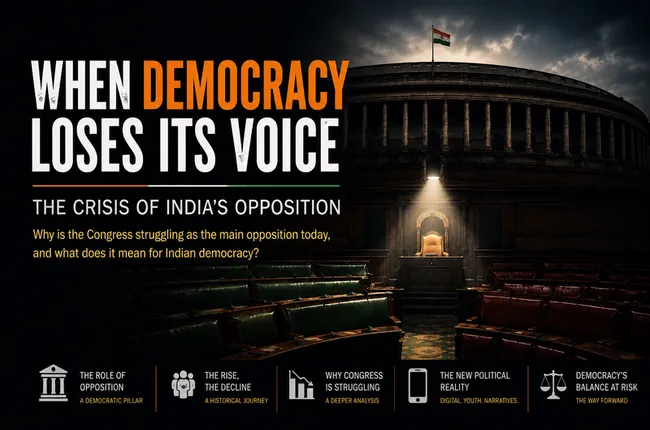
Why is the Congress struggling as the main opposition today, and what does it mean for Indian democracy?
When the world’s largest democracy debates its future, one of its most important voices appears increasingly subdued: the voice of its opposition. The Indian National Congress (INC), or simply the Congress, founded in 1885 by Allan Octavian Hume, was once central to India’s independence and early democratic consolidation. Therefore, it was expected to remain a seasoned and resilient political force.
Yet today, this 140-year-old party struggles to define its place in a fast-changing political landscape shaped by centralised power, personality-driven politics, and the dominance of digital narratives.
Understanding why the Congress has struggled in its opposition role is, therefore, essential not merely to assess the party’s future but to evaluate what this weakness means for the health and balance of Indian democracy itself.
OPPOSITION: A DEMOCRATIC PILLAR
India has lived under a democratic system for nearly eight decades since its independence in 1947. The idea was simple but foundational: political power would never remain unquestioned. The Constitution envisioned Parliament not merely as a site of governance, but as a space of contestation, where competing ideas, dissenting voices, and alternative visions could challenge those in authority. At the centre of this design lay the opposition.
Opposition is not an optional accessory in a democracy; it is a structural necessity. While a government proposes, legislates, and implements policies, an opposition is expected to interrogate decisions, expose failures, demand accountability, and represent citizens who did not vote for the ruling party. Without this counterbalance, democratic authority begins to tilt toward concentration.
In India’s parliamentary system, the role of the opposition extends far beyond numerical strength. It is tasked with questioning laws, scrutinising budgets, challenging executive overreach, forcing debate, and ensuring that governance does not slide into unilateralism. As B.R. Ambedkar warned during the framing of the Constitution, a democracy without an effective opposition risks hollowing itself from within. Elections alone do not guarantee democratic health; continuous accountability does.
How Opposition Worked and Where It Began to Fray
In the early decades after Independence, opposition parties were ideologically diverse but institutionally weak. The Congress dominated national politics during the 1950s and early 1960s, yet Parliament still witnessed substantive debate. Leaders such as Jawaharlal Nehru, despite commanding overwhelming majorities, publicly acknowledged the importance of criticism and parliamentary dissent.
This balance began to shift after 1967. Congress lost power in several states for the first time, coalition governments emerged, and opposition politics entered a phase of experimentation. The Emergency (1975–77), imposed by Indira Gandhi, marked the most serious rupture in India’s democratic practice. At the same time, it triggered an unprecedented consolidation of opposition forces. The Janata Party’s victory in 1977 demonstrated that opposition unity, when grounded in democratic purpose, could successfully challenge entrenched power.
The decades that followed oscillated between instability and renewal. Coalition politics in the 1990s weakened single-party dominance while strengthening parliamentary negotiation. Opposition parties gained leverage even without commanding majorities. Between 1999 and 2014, two large alliances, the NDA and the UPA, alternated in power, with the opposition playing an active role in policy criticism, corruption exposure, and legislative scrutiny. Yet beneath this apparent vibrancy, structural fault lines were already forming.
The Post-2014 Shift: When Opposition Began Losing Ground
The 2014 Lok Sabha election marked a decisive turning point. The Bharatiya Janata Party (BJP) secured a full majority, the first single-party majority in three decades, while the Congress collapsed to 44 seats. This imbalance was not merely electoral; it was institutional.
A numerically weakened opposition struggled to influence parliamentary functioning. Key legislations were increasingly passed with minimal debate. Passing important laws as Money Bills limited the Rajya Sabha’s ability to debate, amend, or block legislation, since a Money Bill can not be introduced in Rajya Sabha. For example, the Aadhaar Act (2016) and the Finance Bill (2017) were passed as Money Bills, a move widely criticised for reducing the upper house’s legislative oversight. Parliamentary committees, long considered the backbone of legislative accountability, saw fewer bills referred to them.
According to parliamentary data analysed by PRS Legislative Research, the 16th Lok Sabha (2014–2019) functioned for significantly fewer hours than earlier Houses, passed large portions of the budget without discussion, referred fewer bills to committees, and relied more heavily on ordinances. While these practices were constitutionally permissible, their cumulative effect weakened Parliament’s deliberative role and, by extension, the opposition’s ability to function meaningfully.
The situation worsened after the 2019 elections, when the BJP expanded its majority further. Congress, the principal opposition, remained fragmented, under-resourced, and often reactive rather than agenda-setting. The absence of a recognised Leader of the Opposition in successive Lok Sabhas became a visible symbol of this institutional weakening.
Why Opposition Matters: Not in Theory, but in Practice
Opposition matters because democracy is not sustained by good intentions alone. It survives through friction. Laws improve when questioned strongly. Policies evolve when challenged. Governance corrects itself when exposed to scrutiny.
When opposition weakens, three consequences follow.
First, accountability declines. Without sustained questioning, executive decisions face fewer obstacles, allowing mistakes to go uncorrected and dissenting expertise to be sidelined.
Second, public debate narrows. Citizens encounter fewer competing narratives, particularly when one political ecosystem dominates media and digital spaces, turning democracy increasingly performative rather than participatory.
Third, institutional checks erode gradually. Courts, media, civil society, and federal structures come under strain when parliamentary opposition cannot amplify concerns or mobilise resistance.
This does not mean that the opposition must oppose every decision of the ruling party. Responsible opposition supports policies that serve national interest while firmly resisting those that undermine constitutional values. Its role is not obstruction, but vigilance.
Fragmentation, Fatigue, and the Crisis of Representation
India’s opposition crisis is not only about numbers; it is also about coherence. Since 2014, opposition parties have struggled to expand their social base beyond traditional vote banks. Identity-based mobilisation, while electorally necessary in some contexts, has also contributed to deeper fragmentation.
Coalitions often emerge from electoral arithmetic rather than a shared governance vision. Unity is forged to defeat the ruling party, not always to offer a stable alternative. As a result, opposition alliances frequently appear reactive, temporary, and ideologically incoherent, weakening voter confidence.
At the same time, pressure on opposition leaders has intensified. Investigative agencies, legal battles, media scrutiny, and resource asymmetries have created an uneven political playing field. Whether viewed as legitimate enforcement or political pressure, the impact on opposition morale and organisational strength has been significant.
A Turnaround that is not Complete
The 2024 general elections altered the landscape once again. The BJP lost its absolute majority, while the Congress improved its tally to 99 seats. The formation of the I.N.D.I.A. coalition signalled renewed opposition coordination. Parliamentary debates became more active, and the presence of a stronger opposition revived expectations of accountability.
Yet this recovery remains fragile. Structural weaknesses such as leadership disputes, organisational gaps, uneven digital reach, and ideological ambiguity continue to limit opposition effectiveness. A stronger numerical presence alone cannot substitute for strategic clarity and institutional rebuilding.
Democracy’s Burden Ultimately Falls on Citizens
Indian political history shows that opposition has never remained strong permanently. It rises, fractures, and rebuilds in cycles. The endurance of democracy depends on whether these cycles are allowed to complete themselves.
Ultimately, democratic power does not rest only in Parliament. It rests with citizens, the voters who must demand accountability, reject hollow majoritarianism, and insist that dissent is not disloyalty. As Abraham Lincoln warned, “Elections belong to the people. It is their decision. If they decide to turn their back on the fire and burn their behinds, then they will just have to sit on their blisters.”
If the opposition fails to speak, citizens must ask why. If institutions weaken, voters must notice. Democracy loses its voice not in a single moment, but through prolonged silence.
And silence, in a democracy, is never neutral.
PERCEIVED AS A ‘ONE-FAMILY’ PARTY
The Perception: Where It Comes From
The INC began in 1885 as a broad, multi-leader platform envisioned by Allan Octavian Hume. In its early decades, the Congress presidents changed frequently, and no single family dominated the organisation. The party brought together lawyers, reformers, intellectuals, and regional leaders, functioning as a collective political space rather than a personality-driven platform.
This character began to shift in the 1920s, when Mahatma Gandhi transformed the Congress into a mass movement and elevated a new generation of leaders. Among them, Jawaharlal Nehru, with his modern outlook, organisational energy, mass appeal, and repeated presidential tenures, gradually emerged as a central figure. His long tenure as India’s first Prime Minister further strengthened this continuity.
After his death, the rise of his daughter Indira Gandhi in the late 1960s marked a second turning point. She centralised organisational authority and reshaped the party’s internal structure. Over time, the repeated emergence of members from the same family at the apex of the organisation turned a historical pattern into a widely held public perception that leadership within the Congress was closely linked to a single lineage, despite the party’s wider national character.
The Impact: How It Affects Leadership Diversity and Morale
By the time Indira Gandhi consolidated power in the late 1960s and later served two major terms as Prime Minister (1966–77; 1980–84), the idea of a Congress leadership centred on one family had become firmly rooted. Her organisational influence, combined with long-term control over party bodies such as the Working Committee and the Central Election Committee, deepened the association between the party and the Nehru–Gandhi lineage.
This continuity extended into the era of Sonia Gandhi, widow of former Prime Minister Rajiv Gandhi. As Congress President for nearly two decades (1998–2017; 2019–2022), she led the party through two national victories but also reinforced perceptions of centralised decision-making. Her son Rahul Gandhi’s brief presidency (2017–2019) and subsequent return as Leader of the Opposition in 2024 further strengthened the impression of dynastic continuity, even as Mallikarjun Kharge’s election in 2022 marked a break after twenty-four years.
Internally, many senior and emerging leaders have linked their exit or frustration to this centralisation. Jyotiraditya Scindia, Himanta Biswa Sarma, Ghulam Nabi Azad, Kapil Sibal, Ashwani Kumar, Hardik Patel, Amarinder Singh, R.P.N. Singh, Milind Deora, Jitin Prasada, and several others cited limited space for growth, lack of consultation, or what they described as ‘family-centric’ decision-making. The G-23 letter of 2020, which demanded transparent organisational elections and collective leadership, became a rare public articulation of this discontent from within the party.
These patterns have appeared across states. In Assam, Himanta Biswa Sarma stated in 2015 in a letter to then Congress President Sonia Gandhi that family-centric politics and a lack of internal democracy compelled him to leave the party. In Madhya Pradesh, Jyotiraditya Scindia’s prolonged dissatisfaction contributed to the collapse of the fifteen-month Congress government in 2020.
Senior figures such as Ghulam Nabi Azad later argued that after Rahul Gandhi was appointed Congress Vice-President, the consultative mechanism was weakened and senior leaders were increasingly sidelined. Kapil Sibal publicly stated that the party no longer allowed adequate space for internal debate, honest dissent, or meaningful participation.
Even leaders who remained inside the party raised concerns. Shashi Tharoor had repeatedly spoken about being sidelined in parliamentary engagement, although he tweeted on X on January 29, 2026, that following a warm and constructive discussion that day, they were all on the same page.
Hardik Patel, former working president of the Gujarat Congress, resigned while accusing the leadership of being indifferent, non-serious, and unable to present a clear roadmap on issues of public importance.
The United Progressive Alliance (UPA) era also reflected a dual-power arrangement, with Dr Manmohan Singh heading the government while major political authority within the party rested with Sonia Gandhi. Analysts frequently described this structure as limiting Singh’s ability to project full political autonomy, despite his acknowledged competence and integrity.
Taken together, these episodes across states and organisational levels illustrate how perceptions of limited leadership space and centralised control have affected morale, innovation, and organisational stability within the Congress.
The Democratic Angle: Why It Matters for India’s Opposition
The perception that Congress is centred on one family does not affect the party alone. It has broader implications for India’s democratic balance. In a parliamentary system, a strong and credible opposition is essential to question the government, scrutinise laws, and present alternative policy visions. When the principal opposition party is widely seen as overly centralised, internally conflicted, or unable to renew its leadership, public confidence in the availability of real political alternatives begins to erode.
Survey findings from CSDS–Lokniti, including the NES (National Election Study) 2014 report entitled “The Defeat of the Congress”, across multiple election cycles, suggest that concerns related to weak leadership, internal divisions, and organisational drift have contributed to voter dissatisfaction with the Congress since 2014. More recent CSDS–Lokniti pre-poll surveys point to declining public trust in the Election Commission, continuing doubts over electronic voting machines, and a divided public perception on whether federal agencies are being used against the opposition or operating within legal boundaries.
A leadership style perceived as overly dependent on one family also complicates alliance-building in India’s multi-party system. Regional parties often fill the resulting space, but rarely form a united national front. This weakens parliamentary debate and increases the dominance of the ruling party. If the Congress were to become more open, competitive, modernised, and internally democratic, it would not only strengthen itself but also help restore balance to India’s political system. A healthy democracy depends not only on the strength of the government, but equally on the strength of the opposition.
NO CLEAR VISION, JUST CRITICISM
Today, India’s opposition faces a serious crisis. Internal disunity, leadership conflicts, external pressure, and the inability to present a credible alternative to the ruling party have steadily weakened its role. These challenges have reduced the opposition’s capacity to question government policy effectively and to perform its essential democratic function.
The problem is not only numerical disadvantage in Parliament, though that has limited the opposition’s ability to influence legislative outcomes. More fundamentally, the crisis reflects a persistent absence of strategic clarity and long-term vision.
At its core, however, the problem reflects a fundamental absence of clear vision.
Reactive criticism over credible alternatives
Rather than advancing clearly articulated policy positions on the economy, national security, or development, opposition parties have largely confined themselves to reacting to government actions through protests, walkouts, and rallies. While necessary, this reactive posture has contributed to a credibility gap. A 2014 Lokniti survey highlighted this imbalance, showing that while the BJP secured 31 percent of public trust on national security, the Congress was trusted by only 19 percent.
The Congress’s response to the Special Intensive Revision (SIR) exercise illustrates this pattern. The party repeatedly described the exercise as ‘vote theft’, ‘unconstitutional’, and a tool to deprive vulnerable voters. However, questioning the legitimacy of electoral processes primarily when outcomes appear unfavourable, while continuing to participate in subsequent elections, has weakened the credibility of such critiques.
A similar pattern appears in debates on rural employment. The Congress has accused the Modi government of ‘bulldozing’ MG-NREGA and ‘destroying livelihoods’ of crores of farmers, labourers, and landless workers. Yet these criticisms have rarely been accompanied by a clearly articulated alternative framework for rural employment or welfare delivery.
Absence of a unified national narrative
Fragmented alliances, including the I.N.D.I.A. coalition, continue to struggle with ideological contradictions and the absence of a shared national vision. Seat-sharing negotiations frequently take precedence over the formulation of a coherent policy agenda. Regional parties remain focused on local priorities, limiting the opposition’s ability to effectively counter the ruling party’s broader ideological and developmental narrative. Even during criticism of the Union Budget of 2025, the lead opposition party failed to present a consolidated or credible alternative economic plan.
Over-reliance on populism and freebies: the ‘revadi’ politics
Electoral promises have increasingly relied on short-term populist measures rather than sustainable economic planning. Karnataka's five guarantees, including ₹2,000 in monthly assistance, reflect this approach. While such measures may yield immediate electoral benefits, they risk weakening fiscal discipline and long -term policy credibility.
In the Bihar 2025 elections, contested in alliance with the RJD, the Congress promised free land for homeless EBC, SC, and ST families, along with cash and housing guarantees.
Similarly, the 2019 Lok Sabha NYAY Scheme, Rahul Gandhi’s flagship minimum income proposal, promised ₹72,000 annually to the poorest 20–25 percent of households at an estimated cost of ₹3.6 lakh crore. The scheme lacked a clear funding or implementation roadmap and was quietly abandoned after electoral defeat.
Himachal Pradesh offers a concrete illustration of these risks. After winning the elections, the Congress promised free electricity up to 300 units, later reducing it to 125 units. The Chief Minister appealed to citizens to voluntarily forgo subsidies even as the state struggled to pay employee salaries on time. The episode highlighted how unchecked freebie politics can place sustained pressure on state finances.
Ultimately, the burden of such populism falls on the taxpayer, creating a cycle that steadily strains public resources.
The present situation of the Congress as opposition evokes a simple metaphor: “If you want your arrow to be longer, lengthen yours, don’t cut someone else’s.” Instead of strengthening its own policy vision and organisational capacity, the opposition has often relied on constant critique of the ruling party. A responsible opposition, however, must function not only as a watchdog but also as a credible governing alternative.
The decline of India’s opposition has been gradual rather than sudden. Since 2014, when decades of Congress-led dominance ended and the BJP came to power, opposition parties have struggled to maintain sustained public engagement. Weak adaptation to contemporary communication platforms, particularly social media, has reduced their ability to shape narratives or remain visible between elections.
In contrast, the ruling party has invested in continuous public outreach through platforms such as Mann Ki Baat and MyGov, reinforcing its presence across social groups and consolidating its communication advantage.
The conclusion is difficult to avoid. India’s opposition cannot revive itself through only louder protests. Its recovery depends on clarity of vision, policy depth, organisational reform, and sustained public engagement.
TALENTED LEADERS IGNORED
The INC has long been associated with leadership concentrated within the Nehru–Gandhi family. Founded in 1885 by A.O. Hume, as a platform to give educated Indians a political voice and facilitate dialogue with the British Raj, the party initially functioned as a broad, collective organisation. Its early political identity was shaped by Mahatma Gandhi’s moral authority and commitment to non-violent resistance, eventually positioning the Congress as the central force in India’s freedom movement and early democratic life.
In the post-Independence period, the party came to be led successively by Jawaharlal Nehru, Indira Gandhi, Rajiv Gandhi, Sanjay Gandhi, Sonia Gandhi, Priyanka Gandhi, and later Rahul Gandhi. Over time, the repeated elevation of members from the same family entrenched a leadership pattern in which the Gandhi surname became inseparable from the party’s highest offices.
A decisive moment in this consolidation occurred in 1969, when the Congress split into two factions: the Indian National Congress (Requisitionists), led by Prime Minister Indira Gandhi, and the Indian National Congress (Organisation/Old), led by senior leaders collectively referred to as the Syndicate. The split emerged from power struggles over policy direction and organisational control. The faction led by Indira Gandhi went on to secure greater public support, reinforcing both her political authority and the centrality of the Nehru–Gandhi leadership in the party’s structure.
While this concentration of leadership enjoyed electoral legitimacy in earlier decades, it has increasingly drawn criticism in recent years. Most key organisational posts, including the position of party president and influential decision-making roles, continued to remain within the Nehru–Gandhi family for extended periods. Critics within the party argue that this concentration narrowed pathways for leadership renewal, leaving several capable and emerging leaders without meaningful opportunities to rise. The result, they contend, has been a steady erosion of internal morale and underutilisation of organisational talent.
Several leaders eventually exited the party after concluding that prospects for advancement were structurally limited. The election of Mallikarjun Kharge as Congress president marked a notable exception, making him the first non–Nehru–Gandhi leader to hold the post in over two decades, but it did not reverse broader perceptions of centralised control.
These perceptions have also been reinforced externally. In an article titled ‘Talented Congress Youth Leaders Sidelined Due To ‘Family Insecurity’: PM Modi’ by Swarajya, it was reported that Prime Minister Narendra Modi, speaking at a meeting with NDA allies, claimed that several young Congress leaders were highly capable but remained marginalised due to what he described as ‘family insecurity’. Although the remark came from a political rival, the article reflected how narratives of internal exclusion within the Congress had gained wider circulation beyond the party.
Over time, the Congress has faced repeated accusations from former insiders of favouritism and ideological rigidity centred on the Gandhi family. Leaders such as Sachin Pilot, Jyotiraditya Scindia, Himanta Biswa Sarma, Ghulam Nabi Azad, Kapil Sibal, Milind Deora, Jitin Prasada, Deepender Hooda, and Sandeep Dixit, all of whom served the party for extended periods, publicly differed with the party leadership on key decisions. Many of them eventually left the Congress and joined rival political formations, deepening the perception of an organisation struggling to retain experienced leadership.
An article titled ‘These are the 5 key young Congress leaders ‘sidelined’ like Jyotiraditya Scindia was’ highlighted claims that several leaders were denied major responsibilities due to apprehensions within the party’s senior leadership that their growing influence could overshadow Rahul Gandhi. The article noted that such perceptions contributed to a growing sense among younger leaders that career progression within the party was uncertain, leading to disengagement and organisational drift.
Internal dissent reached an unusual point of collective expression in 2020. The G-23 letter of 2020, signed by 23 senior Congress leaders, represented a rare collective articulation of this dissatisfaction from within the party. The letter called for transparent organisational elections, institutionalised decision-making, and full-time leadership, signalling concern over the party’s direction and internal democracy. However, these demands did not translate into organisational reform. The Congress Working Committee (CWC) subsequently rejected the letter, with the leadership treating it as dissent rather than a reform proposal, and no structural changes followed.
Specific state-level episodes further illustrate these tensions. Jyotiraditya Scindia ended his 18-year association with the Congress in March 2020 and joined the BJP. His departure followed the Madhya Pradesh Assembly elections of 2018, in which he played a central role in the party’s campaign but was overlooked for the Chief Minister’s post in favour of Kamal Nath. The party leadership’s reluctance to facilitate his entry into the Rajya Sabha further deepened his sense of marginalisation, reinforcing his perception of limited political space within the organisation.
Similarly, Sachin Pilot, who is widely regarded as one of the Congress’s most dynamic leaders, has been denied major responsibilities within the party. During the 2020 Rajasthan Assembly elections, the party did not project a Chief Ministerial candidate. After the Congress victory, Ashok Gehlot was appointed Chief Minister despite widespread expectations that Pilot, then President of the Rajasthan Pradesh Congress Committee, would be chosen following his role in reviving the party in the state.
Criticism has also emerged from leaders who remained within the party. Shashi Tharoor publicly questioned dynastic politics in India and argued for more transparent, merit-based leadership selection. Akashvani News, in an article titled ‘Congress leader Shashi Tharoor Criticises Family Rule in Politics, Calls for Transparent Leadership Selection’ reported that Tharoor argued political leadership should be based on ability rather than lineage, emphasised the need for internal democracy and transparent selection processes, and called for legal restrictions on the tenure of political posts.
These debates are not limited to the post-2014 period. During the UPA era, questions over concentrated authority were frequently raised in public discourse. The article ‘Manmohan Singh: A Puppet or a Leader? A Critical Analysis’ examined Dr Manmohan Singh’s tenure as Prime Minister from 2004 to 2014, analysing claims that his leadership was constrained by the party high command, particularly Sonia Gandhi. Critics and political opponents described him using terms such as ‘weak Prime Minister’, ‘Mauni Baba’, and ‘puppet in the hands of Sonia Gandhi’, reflecting a broader perception of dual power within the party during that period.
Taken together, these episodes suggest that perceptions of family dominance within the Congress have had tangible organisational consequences. The steady loss of experienced leaders, persistent internal dissent, and constrained leadership mobility have weakened the party’s institutional depth. For a party positioned as India’s principal national opposition, these dynamics have implications not only for its internal cohesion but also for the overall quality and credibility of opposition politics in the country.
TOLERATING DIVISIVE VOICES
Allowing extremist or anti-national rhetoric within a party’s ecosystem undermines credibility, weakens public trust, and confuses voters about core values. For the INC, this issue carries particular weight, as the principal opposition is expected to function as a responsible national alternative rather than a reactive political force.
The Congress officially positions itself as a defender of constitutional values, unity, and pluralism. Yet at various moments, statements by its leaders or spokespersons on sensitive national issues have generated controversy without receiving timely or unequivocal clarification from the party leadership. This recurring gap between official positions and uncorrected remarks has produced conflicting public signals.
A prominent example occurred in January 2023, when senior Congress leader Digvijaya Singh publicly questioned the evidence of India’s 2019 surgical strikes following the Pulwama attack. The remarks triggered sharp public and media backlash. Although the party leadership later reaffirmed its support for the armed forces and clarified that the comments did not reflect Congress’s official position, the absence of an immediate and unified response allowed the controversy to dominate the narrative. The issue was not opposition to the armed forces, but the political cost of delayed message discipline.
Similar internal inconsistencies surfaced during the Bharat Jodo Yatra, when public disagreement between Congress leaders Digvijaya Singh and Jairam Ramesh over references to the Pulwama attack and Balakot airstrikes exposed fragmented internal communication. In 2025, senior leader Shashi Tharoor was reportedly admonished by party sources after remarks on the India–Pakistan conflict were described as ‘crossing the Lakshman Rekha’, reflecting continued sensitivity and lack of clarity in handling national security discourse.
Another controversy emerged in December 2025 when Congress leader Prithviraj Chavan described Operation Sindoor as “We were defeated on Operation Sindoor’s first day” and declined to withdraw or apologise, citing constitutional freedom of speech. The statement drew strong political criticism and was widely perceived as disparaging the armed forces, yet no immediate disciplinary response followed from the party leadership.
When such statements are not addressed promptly or decisively, they erode public trust and raise questions about internal discipline and ideological clarity. The impact is particularly pronounced among moderate and undecided voters, who tend to prioritise stability, national integrity, and institutional respect. Perceived tolerance of polarising rhetoric reinforces the impression of the Congress as reactive rather than principled.
In a highly polarised political environment, silence, delay, or ambiguous distancing is often interpreted as acquiescence rather than oversight. Over time, this perception weakens moral authority and deepens scepticism about the party’s seriousness as a national political force.
These episodes also undermine the Congress’s credibility as a governing alternative. An opposition party is assessed not only by its critique of the government but by its ability to demonstrate coherence, disciplined decision-making, and ideological consistency. Persistent internal controversies divert attention from Congress’s substantive positions on unemployment, economic distress, democratic accountability, and federal balance, pushing the party into defensive positions over avoidable remarks.
Restoring public trust requires more than rhetorical commitment to constitutional values. It demands clearer internal boundaries, faster responses to problematic statements, and visible alignment between stated principles and political conduct. Without such discipline, even legitimate democratic criticism risks being overshadowed by perceptions of ambiguity and weak leadership.
WEAK DIGITAL PRESENCE
In the digital age, political influence is shaped less through physical rallies or press conferences and more through online visibility. Social media platforms such as Facebook, Instagram, YouTube, short-form video formats, digital newsrooms, influencers, and WhatsApp groups now determine how rapidly ideas spread, how narratives evolve, and how political impressions are formed. In this environment, the Congress has struggled to establish a strong, consistent, and coordinated digital presence. Although the party maintains official accounts and spokespersons, its online responses are often slow, fragmented, or reactive, allowing opposing narratives to settle long before Congress articulates its position.
This weakness is particularly consequential in a country of India’s scale. With over 1,002.85 million internet subscribers (April-June 2025) and more than 581.6 million Facebook users by May 2024, India represents one of the world’s largest digital electorates. Young voters, including students, first-time voters, unemployed youth, and urban audiences, consume political content largely through short-form digital media. In such a landscape, delayed or inconsistent online engagement risks political invisibility.
The Congress’s digital limitations manifest in several ways: delayed responses during major developments, inconsistent messaging across states, uneven video production quality, limited use of reels and short-form content, and weak WhatsApp penetration. Even articulate party communicators such as Shashi Tharoor, Supriya Shrinate, Jairam Ramesh, and Kanhaiya Kumar are not seen to be integrated into a unified content and response network. As a result, the party frequently loses narrative control during controversies.
The consequences of these digital gaps are visible in how even substantive initiatives fail to gain public recognition. Programmes such as Yuva Nyay, the Indian Youth Congress’s Yodha social media training initiative, and outreach efforts like Apni Baat Rahul Ke Saath address youth concerns and organisational capacity-building without targeting political opponents.
However, they have largely remained confined to party websites, press announcements, and selective social media posts. These initiatives have not been translated into sustained public-facing narratives through short-form videos, simplified explainers, regional-language content, or repeated messaging across platforms where young voters primarily consume political information. The absence of consistent amplification by recognisable messengers and limited digital repetition has meant that such efforts function more as internal exercises than widely visible public interventions, reinforcing the perception of weak digital engagement despite the presence of concrete programmes.
A notable example is the widely circulated 2017 video clip in which Rahul Gandhi appeared to claim that potatoes could be converted into gold. Fact-checkers later clarified that the clip was selectively edited, removing the context in which Gandhi was referencing Prime Minister Narendra Modi’s earlier exaggerated claims. Under the Information Technology Act, 2000, such deliberate distortion and mass circulation could potentially qualify as a cyber-offence. However, no immediate legal or digital counter-action followed. The absence of a swift response reinforced the perception that Congress was ill-equipped to defend itself in the digital arena.
In contrast, the ruling party’s digital operations function with scale and precision, a pattern widely documented in media studies. A nationwide network of IT cell workers, district-level digital teams, volunteers, meme creators, influencers, and WhatsApp groups enables rapid, coordinated messaging. High-volume content production, emotional storytelling, and immediate responses allow the ruling party to dominate digital discourse well before Congress reacts. The result is a persistent asymmetry, with Congress often confined to a defensive position.
This imbalance is also evident at the state level. In Assam, Chief Minister Himanta Biswa Sarma maintains an active digital presence, frequently going live on Facebook and posting regular updates through his PR team. Rather than focusing on direct attacks against the opposition, these communications often highlight events, administrative actions, and decisions, creating a perception of transparency, accessibility, and momentum. This communication strategy keeps grassroots audiences engaged while shaping broader impressions of efficiency and responsiveness.
Digital branding choices further reflect contrasting approaches. On the Indian National Congress’s official YouTube channel, the profile picture features Rahul Gandhi, while the banner displays Mallikarjun Kharge, Sonia Gandhi, and Rahul Gandhi together, inadvertently reinforcing long-standing perceptions of family-centric leadership despite the presence of a non-Gandhi party president. By contrast, the Bharatiya Janata Party’s official YouTube channel uses the party’s lotus symbol as its profile image, while the banner features Prime Minister Narendra Modi and BJP President J.P. Nadda, emphasising organisational leadership rather than family identity. In a visual-first digital ecosystem, such design choices subtly but significantly influence public perception.
The consequences of this digital imbalance extend beyond electoral outcomes. When a single political ecosystem dominates online spaces, citizens are exposed to fewer competing viewpoints, reducing accountability and narrowing public debate. Even when an opposition party offers substantive ideas or legitimate criticism, its impact remains limited unless those messages consistently reach large audiences.
This challenge is not unique to India. Across democracies, opposition parties must sustain advanced digital capabilities to remain politically relevant. A strong digital presence is no longer optional; it is integral to modern political legitimacy. Without it, even credible leadership and well-articulated policies struggle to resonate.
A modernised and coordinated digital strategy by the Congress, integrating content creators, regional communicators, rapid-response teams, fact-checking units, and grassroots volunteers, could help the party reconnect with India’s vast online electorate. In the twenty-first century, a meaningful opposition must compete not only on the ground, but across millions of screens where political reality is increasingly shaped.
DISCONNECT FROM THE MAJORITY POPULATION
In recent years, the Congress is seen to struggle to connect with India’s political middle ground: aspirational, moderate voters who prioritise development, stable governance, cultural acceptance, and region-specific problem-solving without ideological extremism. This disconnection is not merely rhetorical. It reflects deeper shifts in electoral preferences, organisational strength, and the social composition of India’s electorate. Without regaining the confidence of this broad voter segment, the Congress risks being perceived as a peripheral force rather than a credible national alternative.
How the Disconnect Formed
Aspirational Voters and Changing Political Language
A significant portion of India’s electorate, particularly younger voters, lower-middle-class households, and first-time voters, increasingly prioritises economic opportunity, service delivery in education and health, infrastructure development, and a confident national identity. While concerns around climate change, corruption, and governance persist, these are often absorbed through simplified narratives rather than detailed policy debates. Voters respond strongly to leadership that projects visible governance and clear direction, even when such projections are carefully constructed.
Over the past decade, the BJP with its strategic moves, has successfully aligned itself with this evolving aspirational language, blending welfare delivery with assertive cultural symbolism. The Congress, by contrast, has often relied on an older political vocabulary centred on social justice, institutional safeguards, and welfare rhetoric. Although these themes remain relevant in many constituencies, they do not always resonate with voters who prioritise growth, stability, and national pride. As a result, the Congress’s messaging has increasingly appeared disconnected from the expectations of large segments of the electorate.
Secularism Narrative Gap
The Congress has long been perceived as a party committed to minority rights, particularly religious minorities. The ruling party has used this positioning to mount a sustained political charge, alleging that the Congress practises minority appeasement to secure votes. The Congress did not consistently or clearly counter this narrative, allowing it to gain wider acceptance. Over time, many voters from the majority community came to perceive the party as inattentive to their concerns, identities, and cultural anxieties.
In contemporary politics, where cultural recognition and symbolic inclusion carry significant weight, this lack of narrative clarity reduced the Congress’s appeal among voters who seek acknowledgement of identity without endorsing aggressive or exclusionary politics.
Assam illustrates how this perception translated into electoral consequences. The failure of the Congress to effectively address illegal immigration of Assam illustrates how this perception translated into electoral consequences.
Weak Grassroots Presence
Perhaps the most consequential factor behind this disconnect has been the erosion of the Congress’s grassroots machinery. Once the party’s primary strength, its local organisational network has weakened across many states. In contrast, the BJP and its affiliates have expanded their ground-level networks through community committees, social outreach, cultural institutions, and sustained engagement beyond election cycles.
This continuous presence allows the ruling party to shape narratives, respond to emerging concerns, and maintain visibility. The Congress’s organisational activity, by comparison, often intensifies only during elections, limiting its ability to build long-term trust or respond to shifting local sentiments.
Weak Digital Presence
As discussed earlier, the Congress has struggled to adapt to the digital transformation of Indian politics. Political narratives now spread rapidly through short videos, influencers, and WhatsApp networks. The Congress’s delayed responses, inconsistent messaging, and limited digital reach among younger voters have made it appear less visible and less relevant, regardless of its substantive positions.
This disconnect is reinforced by the Congress’s inability to translate even substantive initiatives into broad public awareness. As discussed in the former section, programmes aimed at youth engagement and employment have largely remained confined to formal announcements and limited digital circulation, without sustained outreach through simplified messaging, regional-language content, or repeated visibility across platforms where aspirational and middle-ground voters consume political information. For voters who increasingly judge parties by visible presence rather than stated intent, this gap creates an impression of absence rather than effort, deepening the broader disconnect between policy and perception.
Meanwhile, the BJP operates a fast, coordinated digital ecosystem that saturates platforms with frequent, emotionally resonant, and strategically timed content. State-level leaders maintain active personal digital profiles that project accessibility and momentum. This imbalance allows opponents to shape opinion early, often before the Congress enters the conversation.
Only Criticism, No Solid Vision
The Congress’s public image has also been affected by the perception that it lacks a clear, forward-looking vision articulated as credible alternatives to government policy. Its messaging frequently focuses on critiquing the ruling party rather than outlining a coherent programme of its own. This reactive posture weakens its appeal among voters who prioritise solutions over opposition and makes it difficult for the party to set the political agenda.
Failure to Capitalise on Welfare Gains at the Local Level
Although the Congress introduced several major welfare schemes in earlier periods, it has struggled to convert policy achievements into sustained political support. Weak branding, internal conflict, leadership instability, poor follow-up, and limited grassroots visibility have meant that beneficiaries often do not associate these schemes with the party. In contrast, the BJP has personalised welfare delivery, strengthening its connection with lower-income voters.
Electoral Patterns and Data
These structural and narrative weaknesses have translated into electoral isolation across key battlegrounds.
- In the 2019 general election in Uttar Pradesh (UP), a state with 80 members to the Lok Sabha, the Congress managed only 6.36% of the vote share and 1 seat.
- This decline is consistent with earlier trends: in 2014, the Congress had secured around 7.5% in the state.
- In the 2022 assembly elections in Gujarat, the Congress’s vote share fell to 27.3%, a sharp decline in an industrialised, aspirational state. (The Times of India, 2022).
In Assam, the BJP’s identity-driven campaign and organisational expansion unseated the Congress in 2016, ending 15 years of continuous rule (The Times of India, 2016).
Across multiple states, the Congress’s decline mirrors the rise of parties that combine cultural identity, strong leadership messaging, digital outreach, and targeted welfare delivery. Even in regions where the Congress once dominated, it is increasingly overshadowed by regional parties or the BJP, particularly in constituencies with aspirational middle-class demographics.
Why This Matters for Democracy
The Congress’s weakening connection with the majority population has implications beyond party politics. When a major national party, founded in 1885 and historically representing a broad cross-section of Indian society, loses mainstream appeal, the political centre narrows. The consequences are significant:
- Policy debate narrows, as fewer credible alternatives challenge dominant narratives.
- Checks and balances weaken, reducing effective accountability.
- Voters’ choice shrinks, particularly for moderate voters, sometimes leading to disengagement or NOTA.
- The risk of dominance increases as prolonged imbalance enables centralisation of political power.
In a diverse and plural society such as India’s, democracy depends not only on who governs, but on who can credibly challenge, represent, and offer alternative ideas. A national party disconnected from the middle ground undermines this essential democratic balance.
INTERNAL FACTIONALISM & INSTABILITY
The INC has been a central force in India’s political system for decades. Yet one of the most persistent factors weakening its effectiveness as a national opposition party has been internal factionalism and organisational instability. These internal challenges have repeatedly limited the party’s ability to function as a cohesive, disciplined, and strategically aligned political organisation.
Internal divisions are not new to the Congress. Historically, the party accommodated a wide range of regional, ideological, and social interests. In its early decades, this diversity helped it operate as a broad-based national movement. Over time, however, the same diversity increasingly translated into leadership rivalries and power struggles that weakened organisational coherence. In several states, including Uttar Pradesh, Madhya Pradesh, Rajasthan, Punjab, and Chhattisgarh, factional conflicts have contributed to prolonged instability and, in some cases, the collapse of Congress-led governments.
A major turning point occurred in 1969, when the Congress split into two factions- Congress (R) led by Indira Gandhi and Congress (O). The Indira Gandhi-led faction secured a decisive mandate in the 1971 general election, while the rival faction failed to gain comparable public support. The episode exposed deep leadership divisions and established a pattern of internal fragmentation that would recur in later decades.
Further fragmentation followed in 1979, culminating in the formation of the Congress (I), which the Election Commission recognised as the Indian National Congress in 1981. Although the party returned to power in the 1984 general election under Rajiv Gandhi, it lost office in 1989. These cycles of split, consolidation, and decline reflected recurring leadership disputes and organisational instability, particularly at the state level.
A notable instance of organisational fragmentation after the Congress splits of the 1960s and 1970s emerged from within its own ranks in the late 1990s. In 1998, Mamata Banerjee, a prominent Congress leader in West Bengal, broke away to form the All India Trinamool Congress (TMC) after differences with the party’s leadership. What began as a regional dissent later grew into a major political force, reshaping political competition in the state and beyond. The rise of the TMC shows how internal disagreements can evolve into lasting political realignments, weakening the Congress’s organisational coherence while contributing to the emergence of strong regional rivals.
As electoral dominance declined, the Congress increasingly relied on coalition politics to secure parliamentary majorities. The UPA governments formed in 2004 and 2009 enabled the party to return to power at the Centre under Prime Minister Manmohan Singh. Coalition management, however, remained a persistent challenge. After 2014, the Congress struggled to translate alliances into electoral success and failed to secure the position of Leader of the Opposition in two consecutive Lok Sabha terms.
In 2023, the Congress emerged as a key constituent of the I.N.D.I.A. alliance, bringing together 36 opposition parties. While the alliance did not form the government, the Congress won 99 seats in the 2024 Lok Sabha elections, becoming the largest opposition party for the first time in a decade. Despite this improvement, coordination difficulties within the alliance continued to raise questions about organisational capacity and leadership coherence.
Recent state-level developments illustrate these broader structural issues. In Assam, the state Congress unit’s decision to contest 100 of the 126 Assembly seats ahead of the 2026 Assembly Election generated dissatisfaction among allied and regional parties, who cited a lack of prior consultation. While specific to one state, the episode reflects a wider pattern of strained internal coordination and uneven alliance management. Such instances reinforce perceptions of centralised or unilateral decision-making, which can weaken trust among partners and contribute to organisational instability.
Academic and policy research has consistently identified factionalism as a key weakness of the Congress. A study by the Institute of South Asian Studies titled ‘Congress Leadership Crisis: What it Portends for the Party?’ points to persistent state-level infighting, leadership ambiguity, and organisational fragility. The study documents recurring conflicts in states such as Punjab, Rajasthan, Chhattisgarh, Kerala, and Goa, where leadership disputes and defections have undermined party stability and electoral performance.
Earlier scholarships offer a contrast. In his 1964 study ‘Factionalism and the Congress Party in Uttar Pradesh’, political scientist Paul R. Brass argued that factionalism once played a functional role within the Congress, enabling it to manage social diversity and local power structures during the early years of electoral competition. The contemporary political context, however, has changed substantially. Today, factionalism appears less integrative and more destabilising, as reflected in the party’s prolonged decline across key states and its limited success in organisational rebuilding.
Recent journalistic analyses have linked the continuing exit of leaders and party workers to unresolved internal conflicts, leadership indecision, and repeated electoral setbacks since 2014. The most recent example of internal dissatisfaction surfaced in 2026 is the resignation of Assam’s Bhupen Kumar Borah (former Assam Congress Committee president) and Pradyut Bordoloi (senior Lok Sabha MP from the Congress) and Telangana’s Jeevan Reddy (veteran leader and former minister) from the INC.
After the 2025 Bihar polls, former Union minister Shakeel Ahmad resigned from the party in November 2025 and launched a sharp public attack on Rahul Gandhi. According to a Times of India report, Ahmad, a three-time MLA and two-time MP from Bihar, described Rahul Gandhi as “darpok” (coward) and “insecure”, and accused the leadership of being “dictatorial”. “I was not made part of the decision-making process at any stage” Ahmad alleged, and said he would not join any other party.
Allegations of multiple informal power centres have further complicated internal coordination and weakened organisational discipline. Statements by former Congress leaders who have exited the party, whether contested or not, have reinforced a broader public perception of organisational confusion and weak internal control. Taken together, these patterns indicate that internal factionalism within the Congress is not merely a historical legacy but an ongoing structural challenge, one that continues to raise questions about the party’s readiness to function as a cohesive opposition and a credible alternative governing force.
MISSING THE YOUTH
India’s youth have long played a decisive role in shaping political change, from the freedom movement to more recent elections and social movements. Their energy, idealism, and willingness to question authority have influenced national politics at critical moments. Today, however, this large and influential segment of the electorate remains unevenly engaged by the opposition, particularly the INC.
Over the past decade, youth engagement with politics has shifted decisively to digital platforms. Social media, short-form videos, podcasts, and influencer-driven content now shape how young voters encounter political ideas, assess leadership, and form opinions. In this environment, the Congress and much of the opposition have steadily lost ground in reaching younger audiences.
The Congress’s political communication has often relied on an older style of messaging, including continued emphasis on traditional vote banks and sustained focus on issues such as caste census demands and reservation debates. While these issues remain relevant for sections of the electorate, they have limited resonance among many millennial and Gen Z voters.
Younger voters are more concerned about jobs, quality education, skill development, access to technology, and environmental issues. Their political choices are shaped by practical questions such as whether education leads to employment, whether skills match the job market, and whether economic growth is sustainable in a rapidly changing economy. Although these concerns are widely shared across the political spectrum, the Congress has struggled to position itself as the most visible and convincing political voice addressing them.
This challenge extends beyond policy emphasis to tone and communication style. Since 2014, the BJP has invested in sustained engagement with younger audiences through a combination of leadership-led communication, high-visibility public events, and consistent digital outreach. Prime Minister Narendra Modi has played a central role in this strategy, frequently addressing younger citizens through public programmes and digital platforms.
Early investment in digital communication has enabled the BJP narratives to circulate quickly across platforms such as Twitter, Instagram, and YouTube, supported by campaigns like Viksit Bharat and short-form content collaborations. As a result, opposition messaging has often entered public conversations later, limiting its ability to shape first impressions among young voters.
The Congress has attempted to respond through initiatives focused on youth participation and employment, including the Yuva Nyay pillar, which addresses unemployment, apprenticeships, entrepreneurship, issue of question paper leak and job creation. Youth-oriented efforts such as the Indian Youth Congress’s Yodha social media training programme and Young India Ke Bol, besides outreach initiatives like Apni Baat Rahul Ke Saath have also been launched to strengthen engagement.
However, these initiatives have struggled to achieve wider public visibility. Much of the outreach has remained confined to party platforms, press coverage, or limited digital circulation, reducing its impact among young voters who primarily consume political information through repeated, high-volume, and easily accessible online formats. Compared with more familiar and sustained communication channels used by the ruling party, these efforts have not translated into broad recognition.
Young people today are not politically disengaged. They often respond rapidly to social and political developments, both online and on the ground. At times, when young voices feel excluded or ignored, frustration can intensify. Recent youth-led protests in neighbouring countries, including Nepal, have been cited as examples of how rapidly youth mobilisation can shift from engagement to anger.
In India, this has significant implications. Young voters constitute roughly a quarter of the electorate, placing them at the centre of the country’s political future. The Congress’s difficulty in connecting with this group reflects a broader challenge of adaptation. Outdated political language, limited digital innovation, and weak aspirational storytelling have constrained its appeal among younger voters.
Unless the opposition recalibrates its approach by aligning more closely with youth priorities, strengthening digital engagement, and presenting leadership that appears relatable and forward-looking, this key segment of the electorate is likely to remain under-engaged. The consequence would extend beyond electoral outcomes to a continued weakening of the opposition’s capacity to shape India’s political direction.
WEAK GRASSROOTS NETWORK
A political party’s strength is tested not on television screens or national stages, but at the booth, block, and local cadre level. It is here that voter contact, trust-building, and mobilisation determine electoral outcomes. For the Congress, sustained organisational weakness at the grassroots has emerged as one of the most decisive factors behind its electoral decline and its reduced capacity to function as an effective national opposition.
Organisational Gaps at the Ground Level
Across several states, the Congress’s booth-level and block-level structures remain either thinly staffed or largely nominal. Local committees often lack a continuous on-ground presence, adequate resources, and operational clarity, limiting everyday engagement with voters. Frequent leadership reshuffles and centrally driven decisions, particularly in candidate selection, have further weakened local ownership and disrupted long-term organisational work. As a result, many grassroots workers remain disengaged between elections, activated only during campaign periods, if at all.
In contrast to the cadre-based organisational model of the ruling party, which invests consistently in training, communication, and local leadership development, the Congress has increasingly relied on high-visibility campaigns and national figures. In multiple election cycles, large rallies and leader-centric messaging have substituted for sustained local engagement. While such visibility can generate short-term attention, it cannot replace everyday political presence in neighbourhoods, villages, and urban wards.
This gap is evident in several Assembly and Parliamentary elections, where local Congress units become active only weeks before polling, sitting idle for 5 years before election, while rival party workers remain embedded in constituencies throughout the year through welfare outreach, social engagement, and continuous voter contact.
Mobilisation Challenges and Electoral Consequences
Elections are often decided not by ideology alone, but by organisational efficiency. Weak grassroots networks limit the Congress’s ability to mobilise voters effectively, particularly in closely contested constituencies where margins are narrow. Door-to-door outreach, voter reminders, booth-day coordination, and last-mile logistics all depend on a functioning local apparatus.
The absence of these mechanisms frequently results in lower turnout among traditional Congress supporters and an over-reliance on rallies and centralised messaging. In several closely fought elections, dissatisfaction with the ruling establishment failed to translate into opposition gains, not because of voter apathy, but due to weak organisational conversion of sentiment into participation. Narrow defeat margins in multiple constituencies have repeatedly exposed this mobilisation deficit.
Crisis Response and Political Visibility
Grassroots strength is most visibly tested during moments of local crisis, including communal tensions, economic distress, natural disasters, or governance failures. Parties with deep local networks are often able to respond quickly through visible leadership, relief coordination, and sustained community engagement. The Congress’s weakened ground presence has frequently limited its ability to play this role consistently.
In the absence of a robust local apparatus, responses tend to be delayed, fragmented, or confined to statements by senior leaders. This allows the ruling party to dominate both the physical and narrative space through immediate visibility, administrative reach, and welfare delivery messaging. Over time, this asymmetry shapes public perceptions of relevance and competence, regardless of the substance of opposition criticism.
There have been instances of timely national-level intervention. Rahul Gandhi’s visit to violence-hit Manipur in June 2023, when large parts of the state were engulfed in unrest, is a notable example of early political engagement. However, the long-term political impact of such interventions has often remained limited due to the absence of strong and sustained local organisational follow-through. In many crisis-affected regions, weak or inactive Congress units have struggled to maintain engagement once national leaders depart, limiting follow-up mobilisation and narrative consolidation.
Narrative Vacuum and Democratic Implications
Political narratives are shaped from the ground up. When grassroots communicators are weak or absent, alternative viewpoints struggle to gain traction, and misinformation often goes unchallenged. Congress’s organisational gaps have contributed to a narrative vacuum in several regions, forcing the party into a largely reactive posture rather than enabling it to shape political agendas proactively.
This weakness has broader democratic consequences. A healthy democracy depends on a robust opposition capable of consistently amplifying citizen concerns, scrutinising power, and offering credible alternatives. When the principal opposition lacks depth at the grassroots, political competition narrows, public discourse becomes increasingly one-sided, and democratic accountability weakens.
In this sense, the Congress’s grassroots crisis extends beyond the fortunes of a single party. It reflects a structural imbalance that affects the strength of India’s opposition and, by extension, the quality of democratic contestation itself.
OVER-RELIANCE ON THE TRADITIONAL VOTE BANK
In Indian electoral discourse, the term traditional vote bank refers to social groups that a political party has historically depended on for electoral support over extended periods, often assuming a degree of loyalty rooted in identity, legacy, or long-standing political association.
For the Congress, this has traditionally included religious minorities, Dalit and Adivasi communities, certain caste groups aligned with the party since Independence, and older loyalist voters with a sustained emotional attachment to the party’s role in the freedom struggle.
Across successive election cycles, the Congress has increasingly relied on these traditional support bases as the core of its electoral strategy. Political analysts and journalists have repeatedly observed that the party’s campaigns tend to focus on consolidating outreach among specific social groups, particularly Scheduled Castes, Other Backward Classes, and religious minorities, rather than expanding appeal to newer, undecided, or aspirational voter segments. This pattern has contributed to the perception that the Congress remains anchored to legacy constituencies instead of adapting to evolving electoral dynamics.
This approach was evident as early as 2014. The report titled ‘Congress tries to woo traditional vote bank’ described how the party sought to reclaim the support of slum voters in Delhi after losing them to the Aam Aadmi Party in the 2013 Assembly elections.
A decade later, similar campaign strategies were visible in subsequent Delhi elections. As reported by The Times of India in its article ‘Congress Steps Up its Electoral Campaign’, during the 2025 Delhi elections the party prioritised constituencies with significant minority, Other Backward Class (OBC), and Scheduled Caste (SC) populations, including Mustafabad, Seelampur, Okhla, Babarpur, Chandni Chowk, Matia Mahal, Ballimaran, and Gokulpuri.
The Congress’s continued reliance on traditional vote banks has also drawn sustained criticism from rival parties. In a 2005 press release, the BJP accused Congress-led governments, including those under the United Progressive Alliance, of placing electoral considerations tied to specific communities above broader governance and national cohesion. The statement characterised what it described as ‘minorityism’ and vote-bank politics as prioritising electoral gains over national unity and wider public welfare. While such criticism is partisan, its persistence has shaped how the Congress’s electoral strategy is publicly framed and contested.
Electoral strategies in states such as Bihar further illustrate this pattern. A 2020 Hindustan Times article titled ‘Congress turns to traditional vote base in bid to return to power’ reported that in its list of 70 candidates for the Bihar Assembly elections, Congress fielded 33 candidates from upper-caste groups, including 11 Bhumihars, 9 Brahmins, 9 Rajputs, and 4 Kayasthas. The party also allotted tickets to 13 Dalit and 12 Muslim candidates, communities that historically formed part of the Congress’s core support in Bihar prior to the rise of caste-based politics in the 1990s.
The article quoted political analyst Professor Ajay Kumar Jha, who observed that while Brahmins, Muslims, and Dalits were once central to the Congress’s support base, these groups have since fragmented due to shifting political alignments. He noted that it remains uncertain whether the party’s current reliance on these constituencies can restore its earlier electoral position in the state.
Taken together, these examples point to a sustained dependence on traditional vote banks as a central element of the Congress’s electoral strategy. While this approach contributed to the party’s earlier successes, it has delivered diminishing returns in recent years. The evidence suggests that without broadening its appeal beyond legacy support groups and responding to changing voter expectations, the Congress may continue to face difficulty rebuilding wider and more durable electoral support.
POOR CRISIS MANAGEMENT
For a national opposition party, crisis management is not limited to reacting to emergencies. It also includes how quickly the party communicates, how clearly it takes responsibility, and how effectively it supports its state units during political, social, and administrative crises. In recent years, the INC has often appeared slow, divided, or inconsistent in its responses, affecting its credibility as a serious alternative centre of power.
Today in India, the opposition often struggles to convert major crises and governance failures into sustained political momentum. In several cases, public frustration rises sharply during a crisis, but the Congress has not consistently organised that anger into a coherent narrative, coordinated mobilisation, and long-term political gains. Instead, the party has frequently appeared reactive, allowing the ruling side to shape public perception first.
A recurring weakness has been delayed or unclear communication during high-pressure situations. In several instances, the Congress has taken time to settle on a unified stand, while the government and other actors have already defined the narrative. When responses arrive late, they appear reactive rather than decisive, reducing the party’s ability to set the terms of public debate when attention is at its highest.
The National Herald case illustrates this challenge. Protests organised by local Congress units, including demonstrations in Mandya and Mysuru in late 2025, drew attention but remained localised and did not produce a sustained national message. The party published a detailed clarification in Congress Sandesh on 26 July 2022, in Congress Sandesh on 26 July 2022, outlining its position on the historical loan and related corporate issues. However, since the case dates back to a private complaint filed in November 2012 by BJP leader Subramanian Swamy, the party’s messaging has not consistently dominated public discourse during key phases of the dispute.
Crisis response problems have also appeared during major national moments. After the 2008 Mumbai terror attacks, the Congress-led UPA government faced criticism over intelligence gaps and delays in the security response. Some statements made by senior leaders in the aftermath were also criticised as politically misjudged in the context of national security.
More recently, the Congress has struggled to sustain momentum on public welfare issues even when it raises them sharply. In Delhi in 2025, Rahul Gandhi criticised the ruling party over demolitions of slum dwellings, calling them insensitive and arrogant. However, the party did not sustain a wider campaign that connected the issue to a clear socio-economic alternative.
Internal coordination has further affected crisis handling. The Congress operates through multiple layers of leadership at the national and state levels, and the absence of a clear command structure during urgent moments has often created confusion. At times, senior leaders have issued mixed signals, while different state units have taken conflicting positions, weakening message discipline and making the party appear fragmented.
This was visible in Mangaluru in December 2025, when the Congress workers were detained during a protest against central policy changes, including the proposed replacement of MG-NREGA with a new employment scheme. The protest drew attention locally, but its messaging did not translate into a broader national campaign, and the demands remained fragmented between national objections and local grievances.
Crisis management failures are also visible in the Congress’s handling of political breakdowns in state governments. Internal disputes have sometimes escalated into public confrontation, leading to instability, defections, and in some cases the collapse of governments.
In March 2020, the Congress government in Madhya Pradesh fell after 22 sitting MLAs resigned and later joined the BJP, following the exit of senior Congress leader Jyotiraditya Scindia. In Rajasthan, leadership tensions between Ashok Gehlot and Sachin Pilot triggered a prolonged crisis in 2020, requiring national intervention to prevent a breakdown. In 2022, more than 80 Congress MLAs submitted resignations amid internal disagreement over leadership decisions, again exposing weak crisis control. These episodes reinforced public perceptions of disorder and raised questions about the party’s ability to contain internal crises before they spill into electoral damage.
The party has also faced challenges in responding to governance-related crises such as unemployment, inflation, economic distress, and social tensions. While the Congress frequently raises these issues, its interventions have not always been supported by sustained follow-up, policy clarity, and consistent public communication. During the 2025 to 2026 paddy procurement season in Chhattisgarh, the party boycotted Assembly proceedings over alleged mismanagement affecting farmers. However, the protest remained largely procedural and was not matched by a sustained public campaign explaining alternatives.
Another weakness lies in handling controversies involving its own leaders and public representatives. When disputes arise, the party has not always enforced discipline or issued prompt corrective action. This gives opponents space to dominate the news cycle and frame the Congress as disorganised.
A grassroots example emerged in West Karbi Anglong in late 2025, when over 250 Congress workers resigned in protest against the appointment of a new district president. Many described the choice as inexperienced and argued that long-serving workers had been ignored. The episode raised questions about internal consultation and leadership accountability ahead of the 2026 Assam Assembly elections. As of the latest available reports, there was no widely reported formal response from senior Congress leadership to the mass resignation.
The wider impact of weak crisis management is political. A party that cannot respond swiftly and coherently during crises finds it harder to build public confidence and present itself as a stable alternative. For the Congress, improving this area requires clearer internal coordination, faster decision-making, and stronger message discipline. Without these changes, the party is likely to continue losing ground during moments when the opposition is expected to act with clarity and responsibility.
EXPERT INTERVIEW: STRUCTURAL CRISIS IN CONGRESS – INSIGHTS FROM DR. DHRUBA PRATIM SHARMA
We approached Dr. Dhruba Pratim Sharma, Professor and Head of the Department of Political Science at Gauhati University, who completed his MA, MPhil and PhD at Jawaharlal Nehru University, to understand the structural, organisational and political factors behind the INC’s weakening role as the principal opposition party, and the broader implications this holds for the functioning of Indian democracy. Drawing upon decades of academic research and close observation of Indian political developments, he provided a detailed assessment of the historical evolution, internal functioning, and contemporary challenges facing the party.
Dr. Sharma explained that the centralisation of the Congress leadership around the Nehru–Gandhi family was not an original feature of the party but developed gradually over time. In the years immediately following independence, the Congress functioned as a broad-based national movement rather than a family-centred organisation. Even during Jawaharlal Nehru’s leadership, although Indira Gandhi held a visible political presence and enjoyed a certain amount of prominence, she was not treated as his automatic successor. This was evident when Lal Bahadur Shastri became Prime Minister after Nehru’s death. However, following Shastri’s sudden demise, a section of the Congress leadership actively promoted Indira Gandhi to the top position. Between 1967 and 1971, Indira Gandhi consolidated her position within the Congress party, and her subsequent electoral victories, especially after 1971, further strengthened her authority while reducing the influence of competing leaders.
He observed that the Emergency period marked a decisive shift, as it demonstrated the emergence of informal family influence within the party structure, when Indira Gandhi brought her son Sanjay Gandhi to the fore. Sanjay Gandhi began exercising considerable authority, despite holding no formal constitutional position. After his death, Rajiv Gandhi was brought into politics and later became Prime Minister following Indira Gandhi’s assassination in 1984, with the support of the dominant section of the party. These developments institutionalised dynastic succession and reshaped the organisational culture of the Congress. From this period onward, leadership continuity became closely associated with family lineage rather than internal organisational competition.
According to Dr. Sharma, this long association with one family significantly affected leadership diversity within the party. State-level leaders increasingly depended on approval from the central leadership, which limited autonomous political growth. Loyalty to the central leadership became a crucial criterion for political advancement. He also mentioned that specially after 1971, Indira Gandhi became a leader of the type that the leaders of the party who challenged her power were sidelined, and her supporters remained far below her position, hence making her a very powerful personality within the party. This reduced internal competition and discouraged the emergence of independent regional leaders capable of exercising influence beyond their immediate domains. Over time, this centralisation contributed to organisational rigidity and weakened the party’s adaptability in changing political circumstances.
However, Dr. Sharma strongly opined that the trend or system of family lineage is not always a negative thing until the nation is being served and developing in a proper way. It’s indeed a useful concept for the party, because it helps to control the power fighting and avoid harmful conflict for top leadership. The children of the political leaders already grow up in the environment and learn from their childhood. Therefore the dominant section of the party finds it more convenient to have a person from the family at the top-most position. The same applies for Sonia Gandhi, who originally belongs to Italy, and became a member of the Nehru-Gandhi family after marriage with Rajiv Gandhi. Being the wife of a top-most politician of a country, it’s natural for Sonia Gandhi to develop knowledge in the mechanism of Indian politics and the INC. However, he noted that a political party can function cohesively under a single-family lineage provided the head of that family is able to provide effective leadership.
He further noted that the departure of several senior leaders reflected deeper structural issues within the party’s internal decision-making system. Decision-making had become highly centralised, often confined to a small circle of trusted advisors and senior family members. Leaders who found themselves excluded from this inner circle either remained in marginalised positions or chose to leave the party. However, he emphasised that individual exits did not necessarily destabilise the party structurally, because the Congress retained a widespread organisational presence across constituencies. The larger impact was psychological and symbolic, as repeated departures created a perception of organisational decline and weakened public confidence in its internal democratic functioning.
Dr. Sharma pointed out that the perception of the Congress as a family-centred organisation did not automatically alienate voters. Indian voters, he argued, often prioritise leadership effectiveness over internal party structure. If voters perceive a leader as capable and beneficial to their interests, dynastic leadership does not necessarily diminish electoral support. Indira Gandhi’s leadership, for example, generated strong emotional identification among large sections of the population. However, in contemporary politics, where regional identities and decentralised leadership have gained prominence, excessive centralisation can create barriers to organisational renewal.
Internal factionalism, he explained, has historically existed within the Congress but was previously managed effectively by experienced organisational leaders. Figures such as former President of India, Pranab Mukherjee, played critical roles in resolving internal disputes and maintaining cohesion. These individuals functioned as organisational negotiators who addressed grievances and prevented factional divisions from escalating. In the absence of such strong internal managers today, factional conflicts have become more difficult to control, affecting coordination and organisational stability at both state and national levels.
Despite these internal challenges, Dr. Sharma observed that the Congress has retained its ability to participate in opposition alliances such as the I.N.D.I.A. coalition. He noted that alliance coordination depends not only on the Congress’s internal stability but also on broader strategic calculations among opposition parties. Left parties, in particular, played a crucial role in facilitating cooperation and negotiating seat-sharing arrangements. However, the Congress’s weakened electoral position limited its bargaining strength, forcing it to accept compromises in constituencies where it had previously been dominant.
He also emphasised that the Congress currently faces difficulty in presenting a sharp, clear and coherent national vision distinct from the ruling party. While it continues to uphold traditional ideological commitments such as secularism and social justice, these principles alone are no longer sufficient to mobilise broad electoral support. Contemporary political competition requires a compelling developmental narrative that addresses economic aspirations, governance reforms, and national security concerns in concrete terms. Without such a narrative, the party risks being perceived primarily as a reactive rather than proactive political force.
Message discipline, he stressed, is especially critical for a national opposition party. Uncoordinated or controversial statements by individual leaders can undermine organisational credibility and create confusion among voters. In an era of rapid information dissemination, even minor communication errors can have disproportionate political consequences. Failure to respond promptly to such controversies can weaken public trust and allow political opponents to shape the narrative more effectively.
Dr. Sharma identified communication weakness, particularly in digital political engagement, as one of the Congress’s major structural disadvantages. He noted that while the party possesses experienced leaders and policy proposals, it has struggled to match the ruling party’s speed, coordination, and strategic messaging in digital spaces. Effective political communication today requires continuous engagement, rapid response mechanisms, and professional coordination. Without these capabilities, even well-developed policy positions fail to reach voters effectively.
He also highlighted the party’s difficulty in building sustained engagement with younger voters. Although the Congress has addressed issues such as employment and education, its organisational structure lacks the grassroots mobilisation networks necessary to convert policy proposals into lasting political support. Unlike cadre-based parties, the Congress does not possess a deeply integrated organisational chain that transmits political messaging consistently from national leadership to local communities.
At the organisational level, Dr. Sharma emphasised the critical importance of booth and block-level structures. Electoral success depends not only on national leadership but also on local organisational strength. While the Congress retains formal organisational presence in many regions, its grassroots networks have weakened over time. In contrast, its political opponents have invested heavily in local-level mobilisation, allowing them to convert political support into actual electoral outcomes more effectively.
He observed that the Congress’s reliance on traditional support bases, particularly among minority communities, has not been sufficient to ensure electoral recovery. Changes in political alignments, welfare policies, and leadership perceptions have reshaped voter behaviour. Expanding support beyond traditional constituencies requires sustained organisational outreach and credible leadership at both local and national levels.
Internal disputes and delayed responses to political crises have also affected the party’s public image. Voters expect opposition parties to respond decisively and present themselves as credible alternatives. When responses appear slow or uncoordinated, it reinforces perceptions of organisational weakness. Proactive political engagement, rather than reactive criticism, is essential for restoring political credibility.
Dr. Sharma placed particular emphasis on what he described as the Congress’s structural weakness in crisis response and organisational functioning. He noted that in contemporary politics, the ability to respond rapidly and decisively to political crises has become a defining factor in shaping public perception. According to him, the Congress has repeatedly failed to react with the speed, coordination, and strategic clarity required in moments of political opportunity or institutional crisis. This delay has allowed the ruling party and its allies to dominate public discourse and consolidate their advantage.
He observed that crisis situations, whether related to governance failures, social unrest, or political controversy, present critical opportunities for opposition parties to mobilise public opinion and establish themselves as credible alternatives. However, the Congress has often responded slowly or without a coordinated organisational strategy, preventing it from translating favourable political moments into sustained gains.
Dr. Sharma stressed that this weakness was closely linked to the absence of an efficient internal crisis management structure. He argued that the Congress must develop a dedicated and professionally organised crisis management team whose sole responsibility would be to monitor political developments, assess emerging situations, and formulate rapid and coordinated responses. Such a team, he suggested, should consist of experienced political managers, communication specialists, and organisational leaders capable of immediate action at both national and state levels.
He explained that in earlier decades, the Congress possessed senior leaders who performed this role informally. These individuals acted as political managers who could intervene swiftly to resolve internal conflicts, negotiate with dissatisfied leaders, and maintain organisational unity. Their presence ensured that internal disputes did not escalate into organisational crises. In the absence of such figures today, internal disagreements have remained unresolved for longer periods, weakening the party’s organisational cohesion.
Dr. Sharma also linked the party’s crisis management weakness to its broader communication and organisational deficiencies. He pointed out that rapid and effective communication is essential in modern politics, particularly in the digital age, where political narratives are shaped within hours rather than days. The Congress’s slower communication response has allowed its opponents to frame political events in ways that favour their own strategic objectives. He noted that the ruling party and its organisational network operate with a high degree of coordination, ensuring continuous engagement with both traditional and digital audiences.
He further emphasised that effective crisis management requires strong grassroots organisational networks capable of translating central leadership decisions into immediate local-level action. The Congress’s weakened booth-level and block-level organisational activity has limited its ability to mobilise supporters quickly during critical moments. In contrast, its opponents have built robust local networks that ensure rapid dissemination of political messaging and effective voter mobilisation.
According to Dr. Sharma, improving crisis management capacity would require the Congress to become more proactive rather than reactive. This would involve strengthening internal coordination, empowering organisational managers, improving communication speed, and maintaining continuous engagement with both party workers and the public. He emphasised that without such structural reforms, the party would continue to struggle to counter its opponents effectively, regardless of its historical legacy or ideological position.
He concluded that the creation of a permanent and efficient crisis management mechanism, combined with speedy, improved and effective communication systems and stronger grassroots mobilisation, was essential if the Congress wished to restore its effectiveness as a national opposition party and re-establish its credibility among voters.
CONCLUSION
A Strong Opposition is Vital for Democracy
The analysis presented in this report shows that the crisis of India’s opposition, particularly the weakening position of the Indian National Congress, is not the result of a single factor. It has emerged from a combination of structural, organisational, and strategic challenges that have gradually accumulated over time. Perceptions of centralised leadership, internal factionalism, limited leadership mobility, weak grassroots networks, inconsistent crisis management, and slow adaptation to digital political communication have collectively reduced the party’s ability to function as a coherent and effective opposition force.
At the same time, shifting voter expectations, the rise of aspirational politics, stronger digital ecosystems, and the organisational expansion of rival political forces have further widened this gap. These developments have made it increasingly difficult for the Congress to present itself as a credible national alternative capable of shaping public debate, mobilising public opinion, and holding the government accountable.
The implications extend beyond the fortunes of a single political party. In a parliamentary democracy, a strong and credible opposition is essential for sustaining institutional balance, strengthening public debate, and ensuring accountability in governance. When the principal opposition struggles to organise itself effectively, the broader democratic ecosystem risks becoming imbalanced.
The experience of Indian democracy, however, also demonstrates that political systems evolve through cycles of decline and renewal. The future role of the Congress as a national opposition will depend on its ability to undertake organisational reform, rebuild grassroots structures, communicate effectively with new generations of voters, and articulate a clear and credible national vision.
Ultimately, the strength of a democracy is measured not only by the power of its government, but also by the vitality of its opposition. Ensuring that this balance remains intact is essential for preserving the spirit of democratic accountability in India.
As former Prime Minister, writer and poet Atal Bihari Vajpayee stated during his 1996 Lok Sabha speech, “Satta ka khel toh chalta rahega, sarkarein aayengi, jayengi, partian banengi, bigrengi, magar yeh desh rehna chahiye, yeh desh ka loktantra rehna chahiye. (Power play will continue, governments will come and go, parties will be formed and broken, but this country must live on, its democracy must survive)."